
Executive Summary
Programs that run across different systems create fragmented operations. When you’re managing revenue-driving teams, the last thing you want to deal with is operational overhead. The technology should work together. If it doesn’t, teams end up duplicating work, managing multiple systems, and operating without a clear view of what’s actually happening.
A unified creator program shifts the focus from channel-by-channel execution to a single operating model. The result is fewer internal handoffs, clearer reporting, and better use of lean teams.
Key Takeaways
- Enterprise teams are under pressure to do more with fewer resources.
- Separate creator workflows across Amazon, Walmart, and Shopify create hidden waste.
- A unified creator program improves reporting clarity, reduces duplicated work, and supports lean teams.
- Consolidation is not about removing channel nuance. It is about reducing operational friction.
- Efficiency is now a strategic growth enabler, not just an operations metric. Deloitte’s latest retail outlook shows strong cost pressure and investment re-prioritization across retail leadership.
Why a Unified Creator Program Matters for Efficiency
A typical ecommerce team runs three creator programs, often in silos, not one.
Amazon is managed through marketplace attribution and external traffic tracking. Shopify relies on discount codes, affiliate links, and direct checkout data. Walmart often sits in the background, handled through a smaller workflow or separate initiative.
Each channel has its own system, its own reporting, and often its own owner. The result is more human coordination, not more revenue growth.
A Director of Ecommerce should be focused on driving revenue, managing creators, and making sure they have what they need to perform. For most brands, the bottleneck is operations.
This article will break down:
- Why Amazon, Walmart, and Shopify should be treated as one revenue motion
- What fragmentation actually costs
- What a more efficient model looks like in practice
Why Fragmentation Becomes Expensive
The Hidden Cost of Running Separate Creator Programs
Early on, running each creator program on its own system works. The problem shows up over time, when those systems start overlapping.
Creators are often sourced multiple times across platforms. Each channel has separate briefs, tracked in separate systems, and often reviewed independently by different teams, creating unnecessary duplication.
Lean teams make this worse as headcount isn’t scaling with the complexity of these programs. Time is lost switching between platforms, updating multiple dashboards, and reconciling performance across channels. None of that operational work drives revenue.
Another obvious cost is the platforms themselves. SaaS tools are historically expensive for enterprise teams, and paying for two or even three to run what is essentially the same workflow across channels is a waste.
At the same time, teams are being asked to be more selective with how they invest. Deloitte reports that 76% of executives expect to adjust priorities and 82% plan to shift capital toward more profitable initiatives, which makes inefficient workflows harder to justify.
The larger the organization, the more this duplication compounds. More creators means more handoffs and more reporting layers, which creates more room for inefficiency. At scale, teams spend more time managing the system than benefiting from it.
“Efficiency is doing things right; effectiveness is doing the right things.” — Peter Drucker
Eventually, teams get very good at managing complexity. They build processes, documents, and coordination layers that keep everything functioning.
But the system itself is still inefficient. Instead of improving the overall program, teams instead often optimize how they manage inefficiency.
What a Unified Creator Program Actually Means
A unified creator program is one operating model for recruiting, activating, tracking, paying, and reporting on creators across Amazon, Walmart, and Shopify.
The systems already exist across each platform. The issue is how teams are structured around them.
What a Unified Creator Program Is
- One creator pipeline
- One operating rhythm
- One measurement mindset
- One leadership reporting story
What a Unified Creator Program Is Not
- Not one identical link everywhere
- Not one identical channel message everywhere
- Not a removal of platform-specific rules
These channels may be managed separately by the brand, but the customer does not experience them separately.
The Customer Journey Is Already Cross-Channel
A customer might discover a product through a creator on a social platform, research it further on Amazon, compare options on Walmart, and ultimately purchase through a Shopify storefront.
The modern customer journey is connected, even if internal teams are not.
The Creator Relationship Is One Relationship
A creator is not three different partners just because they operate across three channels. It is one relationship that can influence discovery, consideration, and purchase across multiple channels.
This matters because creators continue to drive real impact. Deloitte reports that 3 out of 5 consumers are more likely to engage with a brand when a creator they trust endorses it.
One Recruitment Motion Instead of Three
Instead of sourcing creators separately for each channel, one recruitment motion can feed all three. This reduces duplicated outreach and improves consistency.
Brands can standardize how they evaluate creators, using the same criteria for audience fit, content quality, brand alignment, and performance expectations. Over time, this leads to a more consistent and higher-quality creator portfolio across channels.
This also creates a more consistent creator lifecycle, from onboarding to activation to ongoing performance management.
A Clean Product Sampling Workflow
Product sampling and sales incentives become fragmented quickly. Different teams send different products, manage different follow-ups, and track results in different places. That creates inconsistent execution and missed opportunities.
A unified workflow can support different commission structures, channel-specific incentives, and unique campaign goals, all while maintaining a consistent internal process.
In many cases, this also introduces automation into parts of the workflow that would otherwise be manual.
A Single Measurement Layer
Disconnected dashboards make it difficult to answer simple questions like which creators are driving incremental revenue, which channels are performing best, and where should the brand invest more?
A unified measurement approach allows for partner-level visibility, channel-level breakdowns, and overall clearer attribution across the full system.
More importantly, it becomes easier to understand which creators are driving incremental revenue versus existing demand.
Amazon Attribution measures off-Amazon traffic and the Brand Referral Bonus rewards it, Shopify enables creator recruiting, gifting, tracking, and payments, and Walmart Creator provides a centralized way for creators to monetize and drive sales through the marketplace.
A Unified Reporting Story
Finance and leadership do not want separate reports for each channel. They want a single view of spend, performance, and efficiency. Leadership is looking at metrics like time to activation, cost per creator, operational overhead, and reporting clarity. These are the signals that drive better decisions.
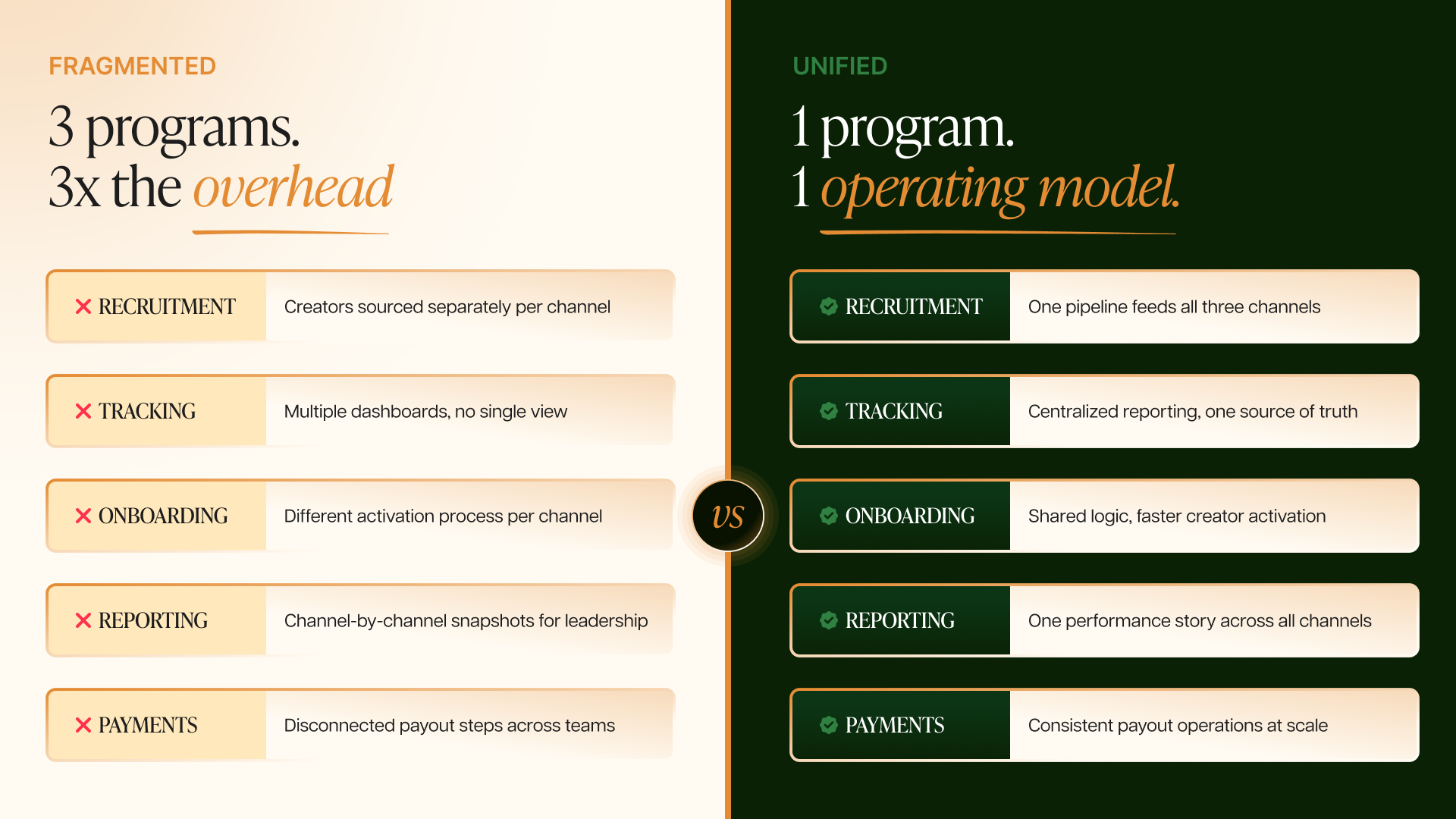
Fragmented Model vs Unified Model
| Operating Area | Fragmented Creator Setup | Unified Creator Program Setup | Efficiency Benefit |
| Recruitment | Separate outreach by channel | One creator pipeline across channels | Less duplicated sourcing work |
| Onboarding | Different activation process per channel | Shared onboarding logic | Faster creator activation |
| Sampling | Manual coordination by team | Shared workflow with channel-specific rules | Fewer missed follow-ups |
| Tracking | Multiple dashboards and spreadsheets | Centralized reporting framework | Clearer visibility |
| Payments | Disconnected finance steps | More consistent payout operations | Less admin burden |
| Compliance | Separate reviews and disclosure checks | Shared standards and review process | Lower risk and less rework |
| Performance reviews | Channel-by-channel snapshots | One partner-level performance lens | Better optimization |
What the Better Operating Model Looks Like
The Strategic Payoff for Enterprise Ecommerce Teams
A unified program reduces the number of platforms teams need to operate daily. Less switching means more focus. Fewer systems mean fewer approvals and fewer dependencies. Execution becomes faster and more predictable.
When workflows are consolidated, teams can manage more output without adding resources. This becomes even more important as more teams bring marketing in-house. Deloitte reports that 94% of retail executives expect to increase in-house activity, which puts more pressure on internal systems to scale efficiently.
Where A Unified Platform Like Levanta Sits
Instead of managing separate systems for Amazon, Shopify, and Walmart, a platform like Levanta brings recruiting, product sampling, tracking, payouts, and reporting into a single system. That allows teams to run one creator program across channels without duplicating work behind the scenes.
The goal is not to change how each channel works, but to remove the operational friction that sits between them.
Why This Matters More in a Cost-Pressured Market
Deloitte reports that 95% of retail executives anticipate rising costs, forcing teams to prioritize efficiency over growth. As costs rise, inefficient systems become more visible. Reducing duplication is one of the fastest ways to protect margin.
A unified creator program also aligns marketing, ecommerce, finance, and leadership around the same data. Teams speak the same language and reports tell the same story, which reduces internal friction and improves decision-making.
Creators remain one of the most effective ways to drive discovery and trust. But better systems ensure that creator relationships generate maximum value across channels.
Strategic Considerations
- Not every creator belongs on every channel
- Channel-specific incentives may still be needed
- Leadership metrics should separate channel output from program efficiency
Operational Considerations
- Define internal ownership early
- Involve finance and legal early
- Document workflow rules before scaling
- Keep channel execution flexible inside a unified operating model
It also makes ownership clearer across teams, which reduces confusion around who manages creators, reporting, and payouts.
This is about running one operating system with channel-aware execution. That is distinctly different from running one identical program everywhere.
Why Operational Efficiency Must Still Be Compliant
Efficiency without compliance creates risk. A unified system makes it easier to enforce consistent disclosure practices across creators.
Plus, fixing compliance issues after the fact is more expensive than building the right system upfront. FTC guidance emphasizes the importance of clearly disclosing material connections between brands and creators.
How Enterprise Teams Can Start With A Unified Creator Program
Step 1: Audit the Current Creator Workflow
Map how creators are recruited, approved, tracked, paid, and reported today. This creates a clear view of how work flows across Amazon, Walmart, and Shopify, including where systems and teams overlap.
Step 2: Identify Duplicated Work
Look for repeated steps across channels, especially in outreach, approvals, reporting, and payouts. In most cases, the same work is happening more than once under different systems or teams.
Step 3: Build One Cross-Channel Operating Framework
Define one creator database, one operating cadence, and one reporting layer. This becomes the foundation of the program. It ensures every creator is managed through the same system, every campaign follows the same rhythm, and performance is measured in a consistent way across channels.
Step 4: Define What Efficiency Means Internally
Track metrics that reflect how the program actually operates. This includes time to creator activation, the number of tools required to run a workflow, reporting turnaround time, payout cycle time, and overall partner manager workload. Over time, these metrics should show that the team is producing more creator output without increasing headcount.
Step 5: Start Small but Standardize Fast
Start with one segment, category, or creator group, then expand. The goal is to establish a consistent way of operating early so it can scale cleanly.
In practice, many brands use a platform like Levanta to centralize this system and avoid rebuilding it manually across multiple tools.
Conclusion
The next phase of growth for a creator program is about efficiency, not scale.
Managing separate creator programs across Amazon, Walmart, and Shopify adds complexity that most teams don’t have the time or resources to support. What looks like growth on the surface often hides operational drag underneath.
A unified creator program removes that friction. It simplifies workflows, improves reporting, and helps teams do more with the same resources.
With Levanta, brands can run one creator program across channels and finally connect performance back to a single, clear system.
Request a demo from Levanta today.
Frequently Asked Questions
What is a unified creator program across Amazon Walmart and Shopify
It is one operating model for managing creator recruitment, tracking, payouts, and reporting across all three channels.
Why does a unified creator program matter for efficiency
It reduces duplicated work, limits internal handoffs, and improves reporting clarity.
Is a unified creator program only useful for large enterprise brands
Enterprise teams feel the impact most, but any omnichannel brand can benefit.
How is a unified creator program different from running separate affiliate programs
Separate programs optimize channels individually. A unified program optimizes the operating system.
Can creators support Amazon Walmart and Shopify at the same time
Yes. One creator relationship can influence multiple purchase paths.
How do brands track creator performance across multiple sales channels
Through attribution tools, discount codes, affiliate links, and centralized reporting systems.
Does a unified creator program reduce costs
It reduces operational waste and improves how teams use their resources.
What are the biggest challenges when unifying creator programs
Internal ownership, reporting alignment, payout processes, legal review, and channel differences.
Do creators need different offers for Amazon Walmart and Shopify
Often yes. But those differences can exist within a unified framework.
What should enterprise teams measure first when consolidating creator operations
Focus on activation speed, reporting clarity, payout efficiency, and overall output per team.