
Executive Summary
Product gifting should be treated like any other marketing channel: structured, measurable, and repeatable. Advertising, discounts, and email are all tracked and optimized over time. Product sampling should be no different.
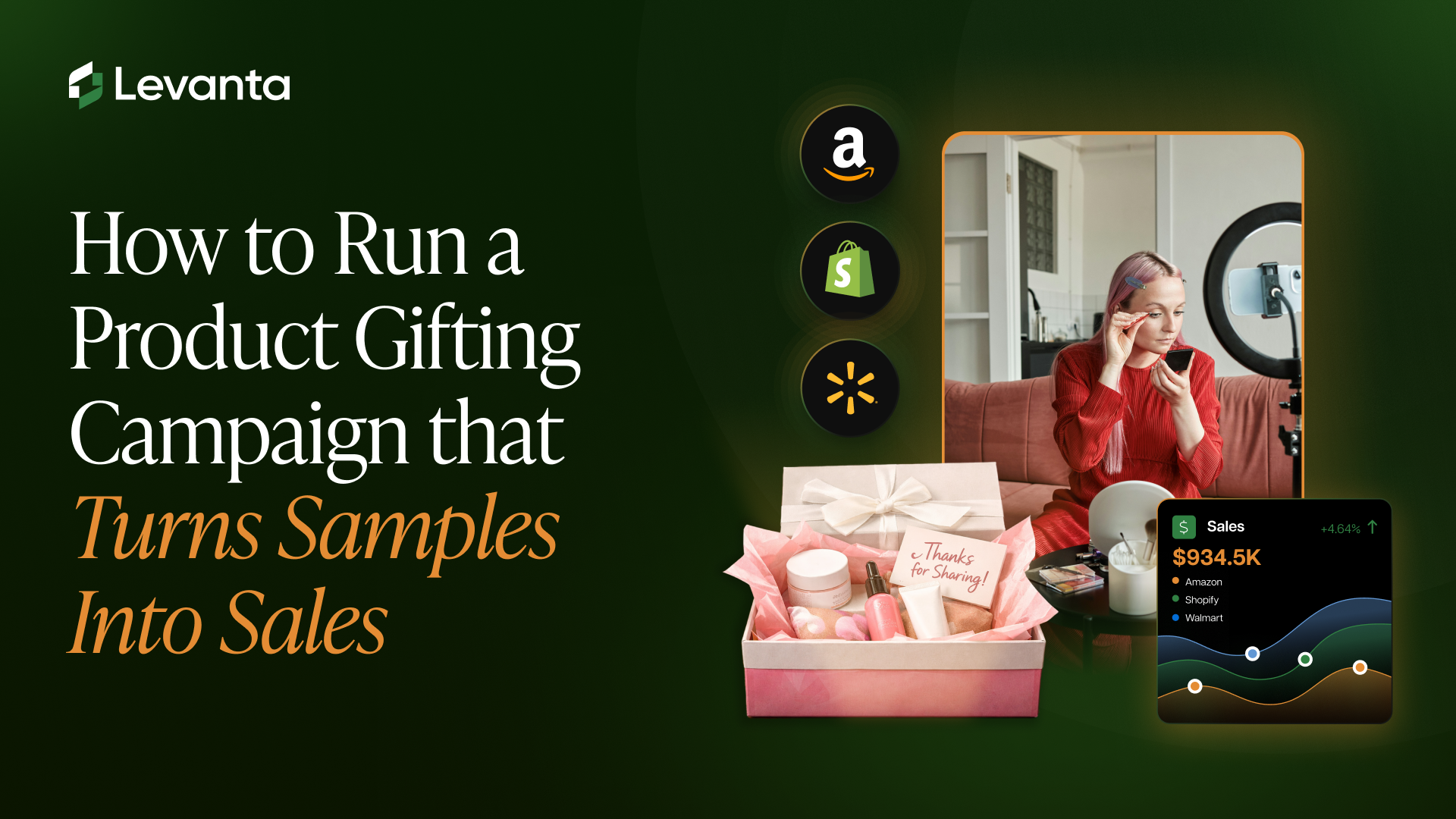
This guide shows how to run a product gifting campaign through a repeatable workflow that drives content creation, distribution, and sales across Shopify, Amazon, and Walmart.
Key Takeaways
You’ll learn how to select creators, design offers, manage operations, track performance, and turn content into conversions.
- Build gifting like a sales funnel: Sample products → creators produce content → content gets distributed → outcomes are tracked
- Use opt-in and clear content angles to increase post rate and quality
- Track with codes, links, and UTMs tied to measurable outcomes, attribution, and incremental revenue
- Repurpose content across PDPs, marketplaces, email, and paid
- Social media product research is rising, reaching ~32% vs 27% in 2023
How to Sample With Structure
When done correctly, product sampling gives creators what they need to do their job and deliver outsized results for your brand.
Most influencer gifting campaigns fail not because of the product, but because there’s no unified structure behind how it’s used.
Creators need clarity. A beauty creator doesn’t know what to do with a kitchen appliance. Even when the fit is right, they still need direction on what to create and why it matters.
Brands need visibility. Without tracking links or codes, there’s no way to understand what’s working or scale what performs.
And most importantly, there needs to be follow-through. Content needs to be reused, distributed, and iterated on to actually impact revenue.
If your gifting experience doesn’t create a reason to try and buy, it won’t move revenue.
Why Free Samples Don’t Convert
The biggest problem brands run into is that sampling is often treated like a one-off action instead of part of a system.
Products get sent to creators who may not drive purchase intent, with no clear reason to create, no direction on what to show, and no structure around how that content connects back to revenue or a broader bundle strategy.
On the backend, it breaks down even further. There’s no guidance on compliance, so creators hesitate or get it wrong. There’s no tracking in place, so performance can’t be measured. Content isn’t effectively distributed or reused, so it fades after a single post. And without any follow-up, there’s no way to learn, improve, or scale.
What looks like a volume problem is actually a systems problem.
The Trust Gap that Gifting Can Solve
Word-of-mouth continues to be one of the most trusted forms of influence. Nielsen reports that 88% of people trust recommendations from people they know over other forms of marketing. While creator is not a direct recommendation from a friend, it feels closer to that than anything a brand can say about itself.
That’s where a gifting program becomes powerful. It gives creators the opportunity to experience a product firsthand and show how it actually fits into their lives. When done well, it creates content that demonstrates use, builds familiarity, and reduces hesitation.
But that trust only translates into revenue when it’s structured correctly. Without clear direction, distribution, and follow-through, even the most authentic content becomes a missed opportunity.
What a Product Gifting Campaign Actually Is
A product gifting campaign is a structured way to get products into the hands of vetted creators so they can generate content that drives measurable outcomes.
It is not sending random packages and hoping something gets posted.
What Product Gifting Is
- Structured seeding designed to generate content and measurable outcomes
- A repeatable workflow that connects product, creator, content, distribution, and performance
- A way to create trust-building content that supports both awareness and sales
What Product Gifting Is Not
- Random PR boxes sent with no selection criteria
- A one-time shipment with no content angle or follow-up
- A substitute for paid partnerships, affiliate strategy, or distribution planning
Quick Definitions
- Gifting: sending product with no guaranteed obligation
- Seeding: targeted gifting tied to a specific outcome
- PR boxes: broader awareness plays, often more brand-forward and less measurable
- Paid partnerships: guaranteed content in exchange for a fee
- Affiliate: a performance-based model where creators earn commission on tracked sales
Why This Matters Now for Shopify, Amazon, and Walmart Brands
The line between discovery and conversion keeps getting blurrier.
Consumers are finding products through creators, then moving straight into channels where they can buy. Sometimes it happens on Amazon or Walmart, sometimes it happens directly on a DTC site. Either way, creator content is often the bridge between interest and action.
A strong gifting campaign can create content that supports Shopify PDPs, improves marketplace creative, fuels email and paid, and gives teams more ways to turn creator relationships into revenue.
Social commerce sales in the US are projected to surpass $100 billion in 2026, which makes creator-led discovery a legitimate revenue strategy, not just a top-of-funnel awareness play.
The “Gifting-to-Sales” Chain
Product gifting only works when you treat it as a sequence, not a one-time event.
A creator receives the product and creates content around it. That content builds trust because it shows the product in use instead of just describing it. From there, the customer has a path to act through a link, code, or direct visit, giving the brand a clearer path to attribution.
That leads to a purchase, and in strong programs, that first conversion can create additional value through repeat purchases, stronger branded search, better-performing creative, or expanded creator partnerships.
Product Gifting Comparison Table
| Lever | Best For | Cost Structure | Tracking Strength | Typical Failure Mode |
| Unstructured gifting | Awareness | Product + shipping | Low | No tracking, no follow-up |
| Structured gifting | Awareness → sales assist | Product + shipping + ops | Medium–High | No distribution |
| Paid influencer | Guaranteed content | Fees + product | Medium | Feels like ads |
| Affiliate-only | Conversion | Commission | High | Slow without activation |
| Ads-only | Scale | CPC/CPM | High | Rising costs |
The Budget Shift Toward Creators
Creators account for ~24% of social marketing spend, as brands prioritize channels that can drive both conversion and earned media value (EMV).
As more budget moves in this direction, the brands that win are the ones turning gifting into a structured, measurable system.
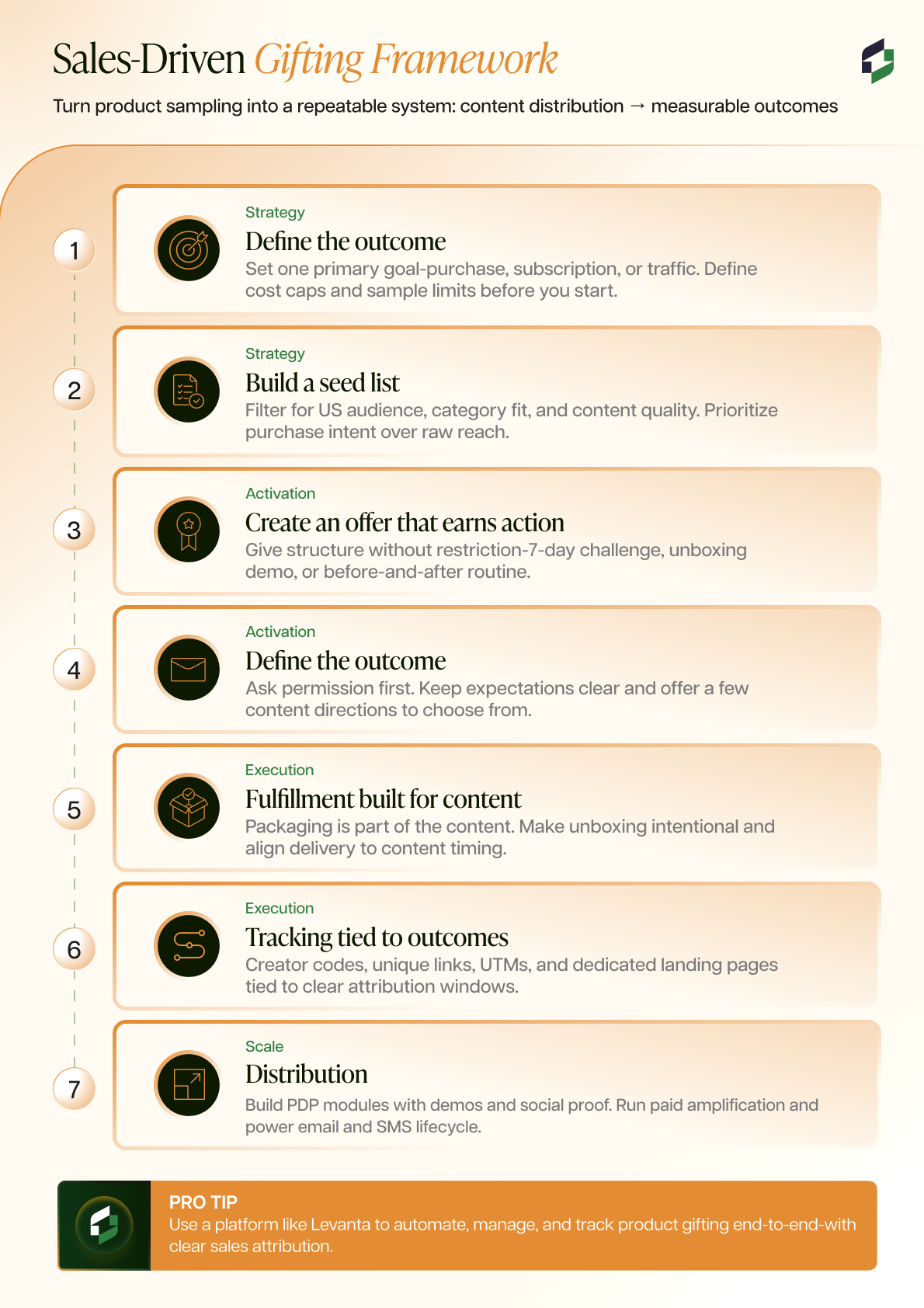
The Sales-Driven Gifting Framework
The framework below breaks down how to turn product sampling into a repeatable system that drives content, distribution, and measurable outcomes.
Step 1: Define the outcome
Start with a single primary goal. On Shopify, that might be a first purchase, subscription start, or multi-product order that improves ROI. On Amazon or Walmart, it could be driving external traffic that converts.
Set guardrails early. Define a ceiling for cost of acquisition, a cap on how many samples you’ll send, and any unit economics you need to protect.
Step 2: Build a seed list that matches purchase intent
Not all creators are equal. Proven category sellers should be prioritized for high-intent outcomes, while high-fit storytellers or UGC creators can support content volume.
At a minimum, filter for US audience, category relevance, and content quality. The goal should be alignment, not reach.
Step 3: Create an offer that earns action
Creators don’t need more free products. They need a story or a reason to create.
The best offers give structure without being restrictive. Use angles like a 7-day results challenge, an unboxing with demo, or a before-and-after routine. Add a timely hook when possible to create urgency.
Step 4: Outreach that increases opt-in
Never assume creators will engage just because you send product.
Ask for permission first, keep the process simple, be clear about expectations, and provide a few content directions to choose from. You’re looking for opt-in and alignment, not creative control.
Step 5: Fulfillment built for content
Packaging is part of the content. A better experience leads to better output.
If your product lends itself to unboxing, make that experience intentional. Include only what’s needed, keep it clean, and ensure delivery timing aligns with when you want content to go live.
Step 6: Tracking that connects to outcomes
Give creators the tools they need to prove impact. That includes creator-specific codes, unique links, UTMs, or dedicated landing pages.
Give creators the tools they need to prove impact. That includes creator-specific codes, unique links, UTMs, or dedicated landing pages tied to clear attribution windows.
Step 7: Distribution
Strong programs take creator content and integrate it directly into the places that drive conversion. On Shopify, that means building PDP modules with demo videos, “how to use” content, and before-and-after proof. On Amazon and Walmart, it shows up as short-form demos, comparison clips, and storefront assets that help shoppers evaluate the product quickly.
From there, the same content can be extended into paid channels through allowlisting or whitelisting, supported by clear UGC licensing and usage rights. It can also power lifecycle channels like email and SMS, where “creator tried it” messaging paired with a bundle or offer helps convert existing demand.
Content creation is the starting point. Distribution is what turns it into revenue.
| Pro Tip: Turn this into a system with Levanta
Platforms like Levanta centralize all seven steps into a single system, making it easier to manage product sampling end-to-end. From creator discovery and opt-ins, to approvals, fulfillment tracking, and performance measurement, everything lives in one place. Levanta reduces manual work and operational friction so the system you build can actually scale. |
Compliance
Gifted products are considered a “material connection,” which means disclosures must be clear and visible, whether that is #gifted, #ad, or plain language in the caption itself. Reference FTC guidelines for specifics.
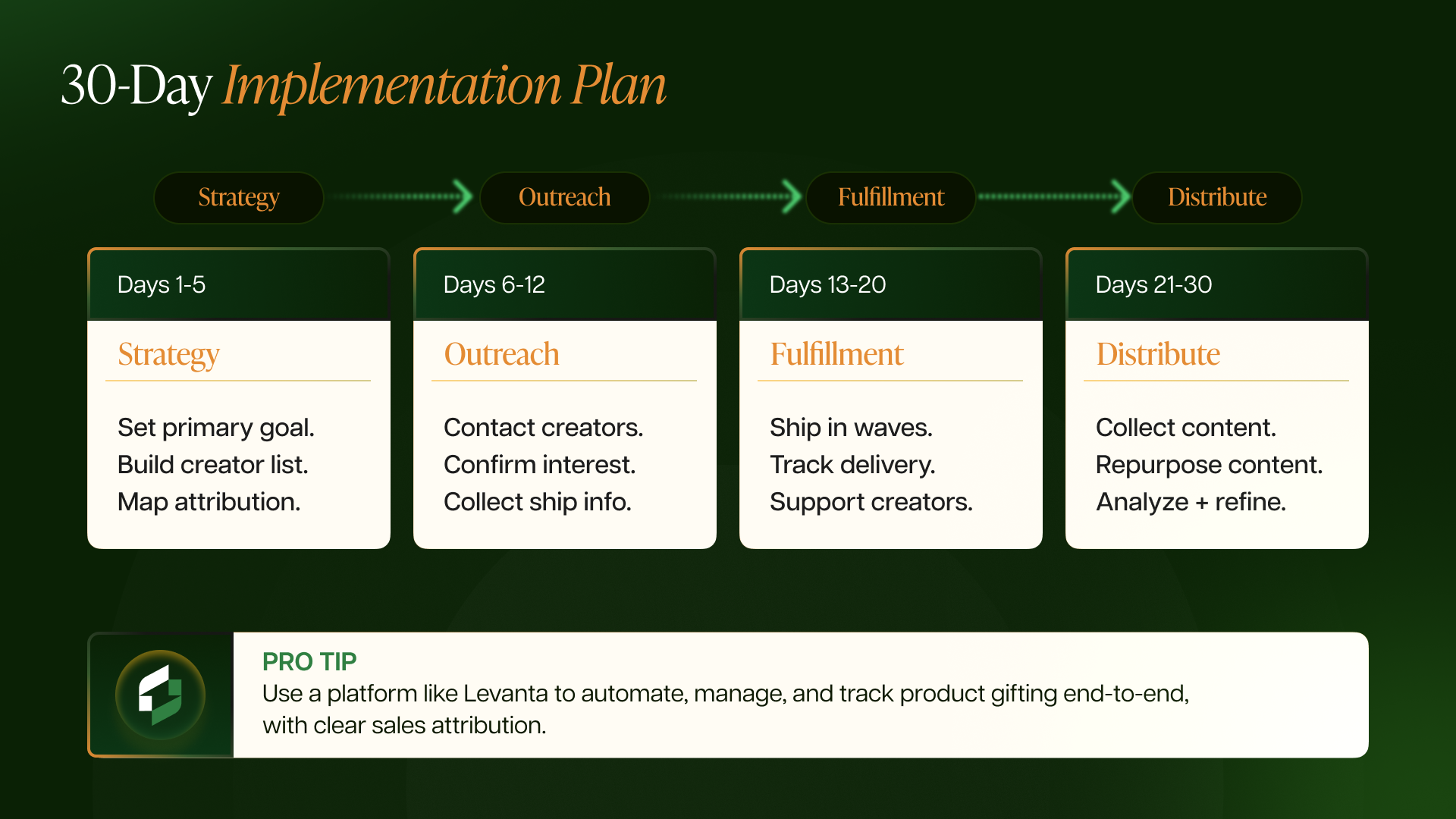
30-Day Implementation Plan
A structured gifting campaign doesn’t need months of planning. You can stand up and run your first version in 30 days if you break it into clear phases.
Days 1-5: Strategy
In the first 5 days, focus on strategy. Define your primary outcome, build your seed list, and map out how you’ll track performance. This is where you make key decisions around creator selection, content direction, and what success looks like.
Days 6-12: Outreach
From days 6 through 12, shift into outreach and opt-ins. Start contacting creators, confirm interest, and collect the information needed to fulfill orders. Keep the process simple and make sure creators understand what they’re receiving and the type of content you’re looking for.
Days 13-20 — Fulfillment
Between days 13 and 20, move into fulfillment and content creation. Ship products in waves, track delivery, and support creators as they begin producing content. Timing matters here, so align shipping with when you want content to go live.
Days 21-30: Measurement and distribution
From days 21 through 30, focus on distribution and measurement. Collect content, repurpose it across your key channels, and analyze performance. Look at what worked, what didn’t, and use those insights to refine your next campaign.
By the end of the 30 days you will have built a system you can repeat and improve each month.
Gifting Campaign KPI Dashboard
A strong gifting program is only as good as your ability to measure it. Without clear visibility into performance through tools like Levanta, Shopify Analytics,Google Analytics, or Amazon Seller Central, you’re just sending products and hoping for the best.
Activity tells you what’s happening. Outcomes tell you what’s working. You need both to be successful.
At a minimum, you should be tracking:
- Opt-in rate (how many creators agree to receive product)
- Delivery success rate (products successfully received)
- Post rate (how many creators actually publish content)
- Content quality (subjective, but critical for reuse and performance)
- Click-through rate (on links provided)
- Conversion rate (how many clicks turn into purchases)
- Code redemption rate (direct signal of conversion)
- Revenue per creator (who is actually driving sales)
- CAC equivalent (product + shipping + ops cost divided by revenue)
- Halo indicators (branded search lift, repeat purchase signals, creative performance)
This is what allows you to move from guessing to decision-making. Over time, these metrics help you identify which creators to double down on, which offers convert, and how to scale the program most efficiently.
Templates
You don’t need complex systems to get started, but you do need consistency. Simple templates and tools make the program easier to run and improve over time.
- Outreach message and follow-up: Keep it short, permission-based, and clear on what the creator is receiving and why it’s relevant to them
- Opt-in form fields: Collect only what’s necessary to fulfill the product and track participation, such as shipping info and channel links
- One-page content brief: Provide 2-3 content angles, key product details, and simple guidance without over-scripting
- FTC-aligned disclosure swipe file: Include examples of clear, compliant disclosures creators can easily copy and adapt
- Post-campaign follow-up message: Close the loop by thanking creators, sharing results when possible, and opening the door for deeper partnerships
These don’t need to be perfect, they just need to be repeatable.
Conclusion
The difference between product gifting that drives results and product gifting that gets ignored is structure.
A structured gifting program turns sampling into a repeatable system that generates content, distributes it across channels, and ties it back to measurable performance.
With Levanta, brands can automate product sampling, manage creator relationships, and track outcomes in one place, making it easier to turn creator content into a scalable growth channel.
Request a demo from Levanta today.
Frequently Asked Questions
Why do gifting campaigns fail?
Gifting campaigns fail because they lack structure, tracking, and a clear distribution plan.
Do creators have to post?
No, unless there is a formal agreement in place, creators are not obligated to post.
Gifting vs seeding vs PR boxes?
Gifting is sending product, seeding is structured gifting tied to outcomes, and PR boxes are typically broad awareness plays.
How many creators should I start with?
Start with a small, focused group, prove ROI, and scale based on performance.
What should be in a PR package?
A PR package should include a strong unboxing experience and clear, simple content direction.
What metrics matter?
The most important metrics are clicks, code usage, post rate, conversions, revenue, and CAC equivalent.
How do I track across Shopify + marketplaces?
Track performance using creator-specific codes, unique affiliate links, and aligned attribution windows.
What disclosures are required?
Creators must clearly disclose gifted products as a material connection in line with FTC guidelines.
What’s the best 30-day timeline?
The most effective timeline follows strategy, outreach, fulfillment, and then measurement and distribution.
When do I upgrade creators?
Upgrade creators when they consistently produce high-quality content and drive conversions.