
Executive Summary
Brands launching a creator program and how to recruit affiliates for a Shopify store often focus on volume over process. The real leverage comes from building a system with a strong foundation that can scale. Treating recruiting like a one-off campaign leads to inconsistencies that more volume alone won’t fix.
When you shift from campaigns to systems, you get a consistent flow of better-fit partners, faster activation and first sales, and a program that compounds week over week.
This guide breaks down exactly how to build that pipeline so affiliate recruiting becomes predictable, not random.
Key Takeaways
- The best way to recruit affiliates for ecommerce is to build a pipeline, not a campaign
- High-performing Shopify brands focus on fit and activation, not just signups
- You need two sourcing tracks: warm (high intent) and cold (predictable volume)
- A simple creator scorecard eliminates low-quality affiliates early
- Your offer and onboarding determine whether creators actually post and sell
Create a Recruiting System
More tools or more creators only works when the rest of the system is operating smoothly. You need a system you can run every week in 60-90 minutes that consistently produces active partners.
If you want a shortcut, Levanta’s creator benchmarking tool can help you sanity-check your category and approach before you start building blindly.
Why Affiliate Recruiting Feels Random for Most Shopify Stores
Why Filtering and Activating Affiliates Matters
Most affiliate programs rely on open application pages and inbound signups with occasional outreach. That creates volume but not outcomes.
Without a simple vetting criteria, approval workflows, or activation plans, you end up with coupon-only affiliates, off-brand creators, or partners who never post.
The volume will come when the system is built, not the other way around.
Competition For Good Creators
Affiliate marketing should be a regular inclusion in a GTM strategy. It’s growing faster than ecommerce overall, which means more brands are competing for the same high-quality creators.
That makes both speed and clarity matter even more. Brands need to not only get to the best creators first, but also be the easiest to work with.
Creators Influence Purchase Behavior
Creators have become a distribution channel, bringing new audiences you don’t already reach, trusted recommendations that convert, and consistent content tied to revenue.
With vetted, bought-in creators, your recruiting pipeline becomes a growth lever.
“We were recruiting creators everywhere, but everything had to flow back into one system. Levanta gave us a way to centralize creator onboarding, sampling, and measurement so we could scale without losing control.”
Combina Key
Director of Brand Operations at REVO
What a Repeatable Creator Pipeline Means and What It Replaces
Pipeline Recruiting vs Random Recruiting
Pipeline recruiting looks like:
- Sourcing daily
- Scoring every creator
- Structured outreach
- Defined onboarding
- Tracked activation
Random recruiting looks like:
- Posting about your affiliate program
- Reacting to inbound applications
- Occasional outreach
One is predictive while the other is reactive.
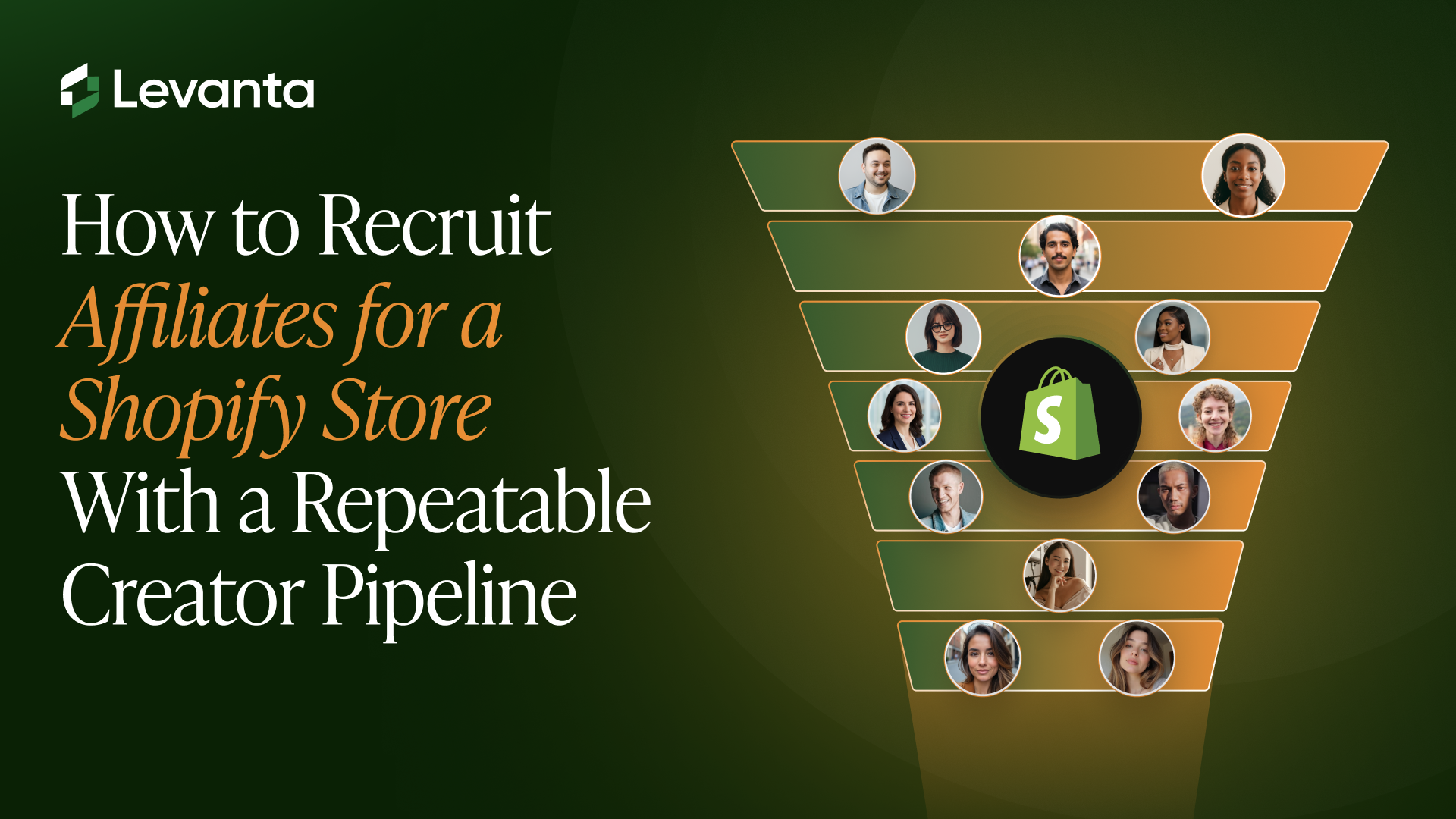
The Pipeline Stages
- Source
- Qualify
- Outreach
- Offer
- Onboard
- Activate
- Retain
Each stage has a job. Skip one, and performance drops.

Product discovery is shifting toward creators, publishers, and niche communities. If you don’t build a system to consistently recruit and activate them, you lose access to that discovery and distribution.
Comparison Table: Choosing Your Recruiting Approach
| Approach | Best for | Pros | Cons | Quality Control Tip |
| Shopify Collabs | Fast setup | Native workflows | Requires vetting | Add a scorecard before approving |
| Application page | Inbound volume | Low effort | Noisy quality | Add disqualifying questions |
| Manual outreach | High-fit creators | High control | Time intensive | Batch outreach daily |
| Affiliate apps & platforms | Scale | Faster sourcing | Mixed quality | Focus on vetted networks like Levanta |
How to Build Your Ideal Creator Profile (ICP)
Define Good-Fit in 4 Filters
1. Audience match (USA + your buyer)
If the audience doesn’t match, nothing else matters.
2. Content format that converts
Look for tutorials, comparisons, routines, product demos
3. Proof of influence (not vanity metrics)
Focus on engagement quality, consistency, and conversion signals, not follower count.
4. Brand fit + compliance readiness
Creators need to align with your brand, understand FTC disclosure, and be comfortable promoting products clearly.
Add Disqualifiers to Prevent Poor-Fit Creators
Not every affiliate or creator is worth bringing into your program. One of the fastest ways to lose momentum is by letting low-quality or misaligned partners into your pipeline.
- Brand bidding: If a partner is only bidding on your branded terms, they’re likely capturing high-intent traffic you would have converted anyway. Without incremental reach, performance can look strong on paper but not actually drive growth.
- Low follower counts or engagement signals: Even if a creator has an audience, low interaction on their content is a strong indicator that they won’t drive meaningful conversions. Engagement quality matters more than audience size.
- Inconsistent or low-volume posting: Creators who don’t publish regularly are unlikely to become reliable partners, even if they seem like a strong fit initially. Consistency is one of the best predictors of performance.
- Poor audience fit: If the creator’s content and audience don’t align with your product, conversion will be a challenge regardless of reach. Relevance should always come before scale.
- AI-generated content: Content that feels automated, repetitive, or low-effort is a sign that the creator may not have a real, engaged audience behind it.
- Coupon-driven affiliates: Coupon partners can play a role, but if they dominate your program, they often capture existing demand rather than create new demand. The goal is balance, not reliance on a single partner type.
- Unclear or missing disclosure: If a creator isn’t consistently disclosing partnerships, it creates compliance risk and can erode trust with their audience. It’s not always a disqualifier, but it’s a signal to review more closely.
The goal is to filter for quality, relevance, and incremental impact early, so you can focus your time on creators who are more likely to perform.
Sourcing: Where to Find Affiliates That Actually Fit
Warm Sourcing: Highest Conversion
If you’re trying to figure out how to find affiliates for a Shopify store, the real advantage comes from knowing where to look and who to prioritize.
Start with:
- Vetted Creator and Affiliate Networks like Levanta
- Customers
- UGC creators
- Email list
- Community members
These convert best because they already trust your product.
Cold sourcing: Predictable Volume
Look for:
- Creators in adjacent categories
- Competitors’ partners
- Educational content creators
This builds pipeline consistency.
Platforms with vetted creator networks can speed this up significantly. Levanta gives brands access to 60k+ vetted creators across publishers, influencers, and media buyers, which helps compress sourcing time.
Sourcing Goal
Start with at least 50 new prospects per day and build from there. Enterprise brands using Levanta often reach out to upwards of 100 new creators daily. Consistency in program growth beats intensity.
Qualification: The Creator Scorecard That Stops Randomness
Score each creator 0-3 across 6 criteria on the following criteria:
- Audience match
- Content type
- Engagement
- Consistency
- Brand fit
- Conversion signals
Based on the final score, set thresholds for outreach urgency:
- A-tier: outreach immediately
- B-tier: nurture
- C-tier: reject
With this creator scorecard, recruiting starts to turn into a repeatable system.
A Repeatable 3-Step Sequence
You can think of this as a simple affiliate recruiting email template for a Shopify store, structured to prioritize speed, relevance, and clarity.
A-tier invites should be short, relevant, and specific. These creators already check every box, so the goal is to move fast and make it easy for them to say yes before another brand does.
B-tier invites should emphasize why your product fits with creators’ audience and what they can earn. They’re a potential fit, but need a clearer reason to engage, so your message should do more of the convincing.
C-tier communications should follow-up with a clear exit. If there’s no response or clear fit, don’t force it, just close the loop and move your time toward higher-probability partners.
With all outreach, be sure to personalize each message for maximum engagement, show the potential value for the creator, and reduce friction and make it as easy as you can for them to opt in.
| Pro tip: If you want a starting point, Levanta’s creator outreach guide includes templates and best practices from high-performing brands. |
Offer Design: How to Attract Good Creators
Creators evaluate lots of variables before saying yes including product fit, earning potential, ease of use, and brand credibility.
In order to build a quality offer, consider using tiered commissions, bonuses, and product seeding. Keep in mind, the offer you send is the first filter for a creator. First impressions matter, so make sure your processes are buttoned up to ensure that interaction reflects your brand.
If you’re unsure how aggressive you can be, tools like Levanta’s LTV calculator can help you understand how much room you actually have to increase commissions without hurting profitability.
We also broke down three common mistakes brands make when working with creators in a short video with REVO, you can watch it here:
Onboarding: Reduce Drop-Off in the First 72 Hours
If you’re thinking about how to onboard affiliates for Shopify, speed and clarity matter more than complexity. Creators should immediately be provided a checklist including:
- Affiliate link
- Product angles
- Assets
- Examples
- Clear expectations
Additionally, the brief should include a first post activation plan.
- Day 1: Welcome and assets
- Day 3: Prompt content
- Day 7: Follow-up and incentives
The moment a creator is accepted is when intent is highest. Capitalizing on that momentum is key.
Activation: Get to the First Sale Faster
Before optimizing performance, make sure your affiliate tracking on Shopify is set up correctly so you can accurately measure what’s working.
The 3 levers that move first-sale time are:
- Content angle
- Landing page
- Incentive
In terms of metrics, track outcomes that matter. Make sure you understand your attribution window, since it determines how credit is assigned to creators and can impact how you evaluate performance.
- Clicks → conversions
- Revenue
- Time to first sale
- % of active affiliates
The most important metric isn’t how many affiliates you have. It’s how many are active and driving revenue.
Retention: Turn One-Off Posts Into a Repeatable Channel
Retention reduces recruiting pressure. When creators stay active, output compounds, performance stabilizes, and growth becomes predictable.
Start by continuing product sampling beyond the initial send. Creators who receive new products regularly have a reason to keep creating, testing different angles, and staying engaged with your brand.
From there, close the loop with feedback. Share what’s actually working, whether it’s a specific content format, hook, or product angle. Most creators don’t get this level of insight from brands, and it makes your program more valuable to them over time.
Finally, layer in incentives tied to continued output. This could be performance-based bonuses, higher commission tiers, or early access to new products. The goal is to reward consistency, not just a single post.
30-Day Implementation Plan
Week 1: Foundations
This week is about clarity, because everything else depends on it.
- Define your ideal creator profile by identifying who your customer is and what type of content actually converts.
- Build a simple scorecard so you can consistently decide who to prioritize, nurture, or reject.
- Set your initial offer, including commission and any early incentives to drive first sales.
- Prepare lightweight onboarding materials so creators know exactly what to do once they’re approved.
Week 2: Build pipeline volume
Now the focus shifts to consistent input.
- Start sourcing creators across both warm (customers, UGC) and cold (niche creators) channels.
- Run every prospect through your scorecard to maintain quality as you scale.
- Begin outreach with a simple, repeatable sequence and aim for 25–50 new conversations this week.
- Don’t overthink messaging yet, just learn what gets replies.
Week 3: Activate
This is where most programs break, so speed matters.
- As soon as creators are approved, send onboarding materials and make it easy for them to take action immediately.
- Prioritize product sampling and remove any friction around links, codes, or access.
- Stay close to your first group and guide them toward their first post and first sale.
- Use small incentives if needed to accelerate momentum.
Week 4: Optimize
Now you turn activity into a system.
- Review who posted, who drove clicks, and who actually generated sales.
- Use that data to refine your scorecard and focus on higher-performing creator types.
- Re-engage active creators with feedback, new angles, and additional opportunities.
- Establish a weekly rhythm so sourcing, outreach, and activation continue consistently.
Conclusion
When you treat recruiting as a repeatable pipeline, you don’t just get more creators, you get better-fit partners, faster activation, and consistent output over time.
This doesn’t require more effort, it simply requires a process you can run weekly that turns sourcing, onboarding, and activation into something predictable.
If you want to build that system without stitching together multiple tools, request a demo of Levanta and see how brands are consolidating sourcing, activation, and performance into one workflow.
Stop treating affiliate recruiting like a campaign, and start treating it like a channel.
FAQs
How do I recruit affiliates for a Shopify store without low-quality signups?
Use a scorecard and strict approval process.
What’s the fastest way to find good-fit creators?
Start with warm sources, then scale with structured cold sourcing. Use an affiliate and creator network like Levanta to source and manage creators in volume.
How many affiliates do I actually need?
A small group of active, high-performing creators will drive more revenue than a large list of inactive affiliates. Focus on quality and consistency over volume.
What commission rate should I offer?
Test tiers and incentives. Avoid one-size-fits-all rates.
How do I prevent coupon sites from taking credit?
Set clear policies and attribution rules.
How do I get creators to post consistently?
Build a monthly rhythm and offer incentives tied to output.
Do creators need to disclose commissions?
Yes. FTC guidelines require it.
Do I need to send a 1099?
In many cases, yes. Check IRS guidelines. Levanta automatically sends relevant tax documents to all creators in your program without additional work on your end.
How many creators should I invite daily?
Start with 50 per day at a minimum and adjust based on performance.
What metrics matter most?
- Active creators
- Ad-to-Carts
- Conversions
- Time to first sale
- Revenue generated