
TLDR
| Setting competitive affiliate commissions isn’t one-size-fits-all. The right rate depends on your product category, ratings and reviews, marketplace (Amazon, Walmart, or Shopify), margin structure, and what type of creator you’re working with. Marketplace sellers can offset commission costs through Amazon’s Brand Referral Bonus (~10% back) and Walmart’s Commission Contribution (~4% back), while Shopify sellers benefit from having no platform referral fees at all. The smartest brands go further by tailoring commissions at the product level and creator level, and by using different payment models — from performance-based CPS to flat-rate paid placements and hybrid deals — to attract the right mix of affiliates, publishers, and creators. |
Why Your Affiliate Commission Strategy Matters More Than Ever
For any brand new to affiliate marketing, one of the first questions is: what commission rate is actually competitive enough to attract quality affiliates and creators?
There’s no single answer, because multiple factors are at play including your product category, customer reviews, timing, margins, and which marketplace you’re selling on. Understanding how these factors influence creator behavior can help you structure commissions that genuinely motivate partners to promote your products, whether they’re publishing on Amazon, Walmart, Shopify, or across all three.
The brands that win at affiliate marketing also understand that commission rate is only one piece of the puzzle. How you structure deals — percentage-based commissions, flat-rate creator partnerships, or hybrid models that combine both — can be just as important as the number itself.
Key Factors to Consider When Setting Affiliate Commissions
Product Category and Competitive Benchmarks
When it comes to product categories, some are more enticing for affiliates than others, and some are far more competitive.
The most attractive categories for affiliates tend to share a few things in common: higher average order values (AOVs), low-consideration products that don’t require extensive research before buying, and high search volume. If there isn’t strong demand for a product, it’s going to be difficult for affiliates to drive meaningful sales — no matter the commission rate. If your product category doesn’t check those boxes, offering a higher commission is often necessary to persuade affiliates to promote you.
Some categories also come with higher cost-per-acquisition (CPA) expectations than others. Two of the most competitive are beauty and supplements.
Beauty
Established brands are constantly trying to stay relevant, while new brands are always entering the market trying to stand out. On top of that, beauty is a brand-loyal category where consumers tend to stick with products they already trust. Because of this, offering 20% commission often isn’t enough to get the attention of larger affiliates and publishers. Many beauty brands end up needing to offer 40% commission or more to get meaningful coverage, especially from major content creators and editorial publishers.
Supplements
Supplements work differently than most consumer products. They’re not a “buy it once and see results right away” type of product. Instead, they require time, consistency, and a lot of social proof, especially since results vary from person to person. However, if even one customer becomes a loyal repeat buyer, that can generate significant long-term revenue. As a result, supplement brands often offer commissions of 40–50%, sometimes even 60%, because they know the lifetime value of a converted customer will more than pay for it.
These benchmarks hold true whether you’re selling on Amazon, Walmart, or through your own Shopify store. The difference is in how each marketplace affects your net cost, which we’ll cover below.
Ratings and Reviews
Customers care deeply about what other customers have to say. With so many options available across every marketplace, reviews are more important than ever when it comes to purchase decisions.
When structuring commissions, ratings and reviews matter to affiliates and creators when deciding if they will promote your product. Affiliates want to promote products that have the best chance of converting, because their income depends on it.
If your product has less than 4 stars or fewer than 1,000 reviews, it’s often worth being more aggressive with your commission rates. A higher commission can make affiliates more willing to take a chance on a product that might not convert as quickly. This is especially true for new product launches. To an affiliate who has never worked with your brand, they don’t know what to expect. It helps to let them start by promoting a best-seller or a higher-reviewed product so they can see success with your brand first and then expand to newer, less-reviewed SKUs once they’ve built confidence in your catalog.
Timing and Program Maturity
The more competitive your commissions are out of the gate, the faster you’re likely to see initial results. But affiliate marketing is ultimately about building long-term relationships and sustainable growth.
Depending on your goals and timeline, timing plays an important role in how you structure commissions. Early-stage brands may need to offer aggressive rates to build their affiliate roster, while established brands with proven conversion rates can afford to be more strategic. Consider launching with a promotional commission rate for the first 60–90 days to attract early partners, then adjusting as you gather performance data.
Margins Across Marketplaces
Not every product needs an extremely competitive commission rate. In some cases, even commissions as low as 5% can be enough to attract certain affiliates especially if the product already has strong demand or a high price point.
It’s also important to understand how marketplace economics actually work in your favor when it comes to affiliate commissions. While Amazon and Walmart do charge referral fees, both platforms also give money back to sellers who drive external traffic. Amazon’s Brand Referral Bonus returns an average of ~10% per sale, and Walmart contributes ~4% toward creator commissions. These offsets mean that marketplace sellers can often afford to offer more competitive commission rates than you might expect because a significant portion of that commission is effectively subsidized by the platform.
Shopify, on the other hand, has no marketplace referral fees, which simplifies the math and gives you the ability to be more aggressive with the commissions you offer creators.
Tailoring Commissions by Creator Type and Payment Model
One of the most overlooked aspects of affiliate commission strategy is that not every affiliate or creator needs to receive the same commission.
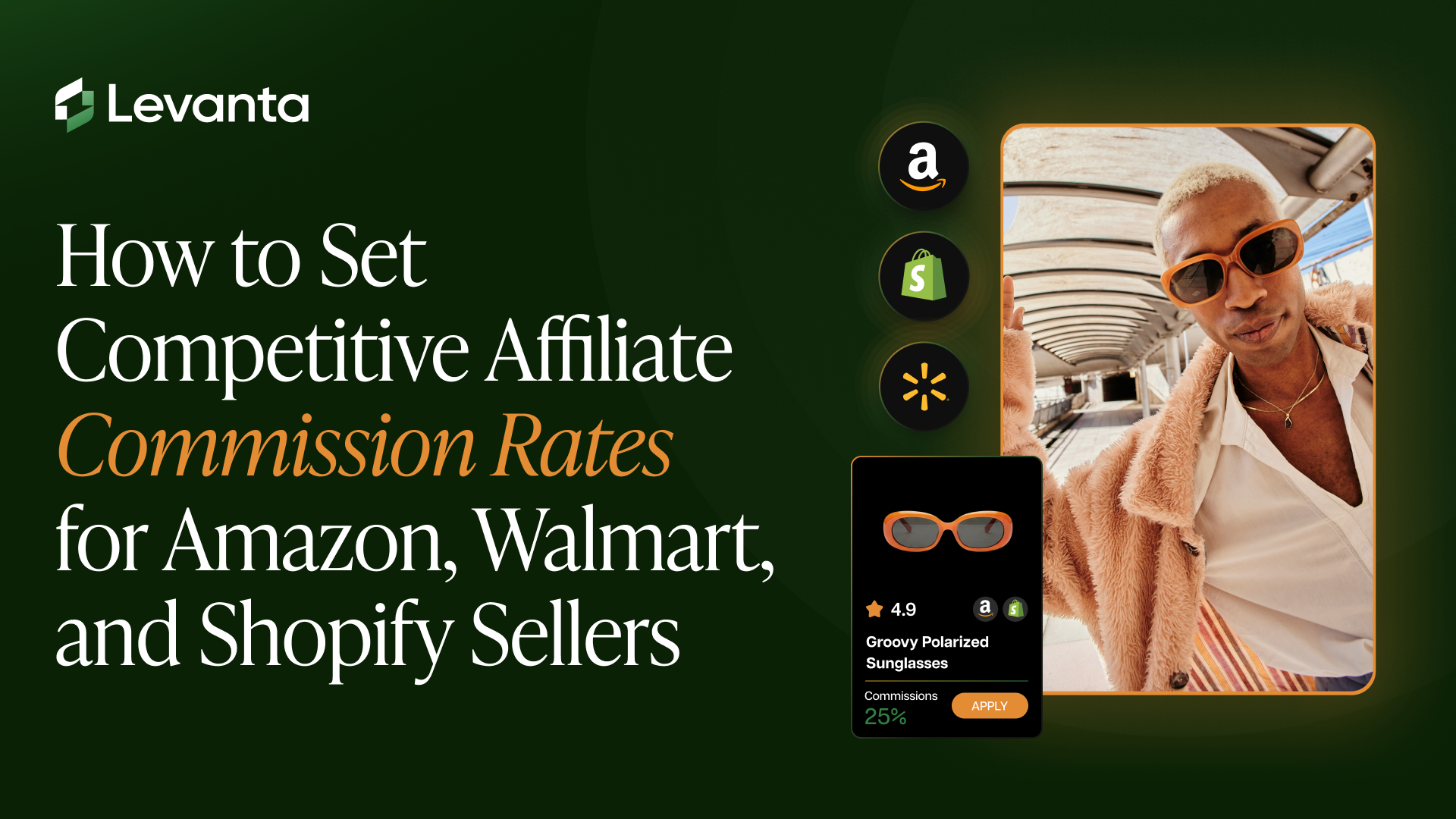
With a platform like Levanta, you can structure commissions at both the product level and the creator level, giving you fine-grained control over how you compensate different partners.
Performance-Based (CPS) Commissions
The most common affiliate model is cost-per-sale (CPS), where creators earn a percentage of each sale they drive. This is pure pay-for-performance and works well for affiliates, publishers, and deal sites that are already driving high-intent traffic.
You might offer 15% commission to a large editorial publisher who drives volume, while offering 25% to a niche micro-influencer whose audience is a perfect fit for your product. The flexibility to set different rates per creator lets you optimize for ROI across your entire affiliate mix.
Flat-Rate Paid Placements
Not every creator partnership fits the CPS model. Many influencers and content creators, especially those who drive top-of-funnel awareness, prefer guaranteed compensation for their work. With Levanta’s Paid Placements, brands can negotiate flat-rate deals for guaranteed content creation and placement, while still tracking full-funnel performance (clicks, detail page views, add-to-carts, and conversions) through Levanta’s affiliate performance measurement.
This model is particularly effective for brands launching new products where there’s no conversion history to point to, or for working with creators whose audience is highly engaged but may take longer to convert.
Hybrid Models
The hybrid approach combines a flat fee with a performance-based commission giving creators a guaranteed base payment for their content work, plus upside if the content drives sales. This is often the sweet spot for mid-tier creators.
For example, you might offer a creator $500 for a dedicated product review video plus 10% commission on all sales attributed to their links. This gives the creator financial security while keeping them motivated to drive results and it gives you measurable performance data on what was traditionally an “awareness-only” spend.
Structuring a Diversified Creator Mix
The most successful affiliate programs use a combination of all three models across different creator tiers:
- Editorial publishers and deal sites: Commissions, optimized for volume and conversion
- Mid-tier influencers and content creators: Hybrid deals (flat fee + commission) for guaranteed content with performance upside
- High Authority creators or publisher domains: Flat-rate Paid Placements for guaranteed exposure with full-funnel attribution
How Marketplace Referral Bonuses Offset Your Commission Costs
One of the biggest advantages of affiliate marketing for marketplace sellers is that both Amazon and Walmart offer financial incentives that effectively reduce your net commission cost.
Amazon’s Brand Referral Bonus (BRB)
The Brand Referral Bonus is Amazon’s incentive for sellers who drive traffic from outside Amazon to their product listings. As competition from other retailers and D2C brands continues to grow, Amazon wants to remain a primary shopping destination, so they reward sellers who send external traffic back to the platform.
Eligible third-party brands can earn an average of 10% back on each sale generated from off-Amazon traffic (the exact percentage varies by product category, ranging from roughly 5% to 45%). While it’s not a direct payout, Amazon applies the bonus as a credit against referral fees, effectively reducing your selling costs.
This means that if you’re offering a 20% commission to an affiliate, your net cost after the BRB could be closer to 10%. That’s a significant difference when calculating your return on affiliate spend.
To calculate your specific bonus, visit Amazon’s Brand Referral Bonus page.
Walmart’s Commission Contribution
Walmart offers a similar but distinct incentive. Through Levanta’s integration with Walmart Marketplace, Walmart contributes an average of 4% toward creator commissions on sales driven by external affiliate traffic. This contribution directly reduces the commission cost for sellers while making campaigns more appealing to creators.
While 4% may sound modest compared to Amazon’s BRB, it’s an additive benefit that improves unit economics on every affiliate-driven sale and it signals Walmart’s growing commitment to external traffic and creator-driven commerce on their platform.
Shopify: No Platform Fees, Full Margin Control
For brands selling on Shopify, the commission math is different and, in some ways, simpler. Shopify doesn’t charge marketplace referral fees the way Amazon and Walmart do, beyond standard payment processing fees.
The upside is that you have full control over your economics. The trade-off is that there’s no marketplace-funded bonus to offset commission costs. Shopify sellers need to factor in their full customer acquisition cost when setting commission rates, but they also benefit from owning their customer data and relationships which have compounding value over time.
Thinking Omnichannel
For brands selling across Amazon, Walmart, and Shopify, the smartest commission strategy accounts for the unique economics of each channel. You might offer a higher base commission on Amazon where the BRB gives you ~10% back, a moderate rate on Walmart with the ~4% contribution, and a slightly different structure on Shopify where you keep more margin but don’t get a referral bonus. With Levanta, you can manage all of this from a single platform and tailor your commissions per marketplace, per product, and per creator.
Customer Lifetime Value: The Real ROI of Affiliate Commissions
LTV (lifetime value) represents the total revenue a customer generates over time:
LTV = Average Order Value × Average Number of Purchases per Customer
As your brand grows beyond the launch stage, you begin building a customer base and brand presence that can generate far more value than any single transaction.
Many sellers focus only on their initial product margins, but brands that understand affiliate marketing know how powerful it can be for generating long-term customer value. This is especially true for subscription products. If you sell through Amazon’s Subscribe & Save, Walmart’s subscription options, or a Shopify subscription model, the lifetime value of a customer can grow exponentially.
Why Supplement Brands Can Afford 60% Commissions
Thinking back to the supplements example — how can brands afford to offer up to 60% commissions while staying profitable? The answer is LTV.
These brands are willing to pay high commissions because they know that if a first purchase turns into a repeat customer or subscription buyer, that single customer could generate significant additional revenue over time.
For example, say your product costs $120 and you offer a 60% commission. You may only net $48 from the first purchase. But if that customer continues buying — or subscribes — that could turn into multiple $120 purchases over the following year. The initial commission investment pays for itself many times over.
New-to-Brand Customers
When affiliates and creators promote your brand, they’re often reaching customers who have never heard of you before. This allows your brand to become more top-of-mind, leading to increased traffic, more branded keyword searches, and greater overall awareness.
Even if a purchase doesn’t happen immediately, exposure still matters. Research from Infillion and Retail TouchPoints found that consumers now engage with brands across an average of 11 touchpoints before making a purchase. This underscores why affiliate marketing, and particularly a diversified mix across multiple marketplaces and channels, is so valuable. Every creator post, editorial mention, and product review is another touchpoint bringing customers closer to conversion.
Subscribe and Save / Subscription Customers
If new-to-brand customers buy and enjoy your product, they’re far more likely to purchase again. For subscription-based brands, this is where the real value compounds. You may give away a large commission once, but that customer could generate several full-price purchases with no additional acquisition cost.
Organic Ranking and Compounding Returns
Driving external traffic that converts on Amazon or Walmart can also help boost your organic search ranking on those platforms. Stronger organic rankings lead to more organic sales, which can reduce your reliance on PPC advertising and improve your overall margins. This creates a positive feedback loop: affiliate-driven traffic improves rankings, which drives more organic sales, which frees up budget to invest in more affiliate partnerships.
And when those customers leave positive reviews, which they’re more likely to do as new, enthusiastic buyers, the cycle continues. More reviews lead to higher conversion rates, which makes your products even more attractive to affiliates.
Final Thoughts
When structuring your affiliate commissions, it’s essential to look at the bigger picture.
Factors like category competitiveness, product reviews, program maturity, margins, marketplace referral bonuses, payment models, and long-term customer value all play a role in determining what commission rate and deal structure makes sense for your brand.
The brands that see the most success with affiliate marketing understand that commissions are an investment and not just a cost. And with the right platform, you can tailor every aspect of your commission strategy by marketplace, by product, by creator type, and by payment model to maximize your return.
Ready to build your commission strategy? Check out Levanta’s commissions calculator to see how these metrics work for your business. Or get started with Levanta to launch your affiliate program across Amazon, Walmart, and Shopify.
Frequently Asked Questions
What is a good affiliate commission rate for ecommerce?
The average affiliate commission rate for ecommerce ranges from 5–30%, depending on the product category and margin structure. DTC brands on Shopify typically start at 10–15%, while marketplace sellers on Amazon and Walmart need to factor in referral fee offsets (like Amazon’s Brand Referral Bonus) when calculating their effective commission cost. Highly competitive categories like beauty and supplements often require 30–60% to attract top-tier affiliates.
Should I offer the same commission to every affiliate?
No. The most effective affiliate programs tailor commissions by creator type, performance tier, and partnership model. With platforms like Levanta, you can set different commission rates at the product level and the creator level — offering higher rates to proven performers, lower rates on high-AOV products, or different deal structures (CPS, flat-rate, hybrid) depending on the partner.
What is Amazon’s Brand Referral Bonus and how does it affect my affiliate costs?
Amazon’s Brand Referral Bonus (BRB) gives eligible brands an average of 10% back on sales generated from external traffic, applied as a credit against referral fees. This effectively reduces your net affiliate commission cost. For example, a 20% commission might only cost you ~10% after the BRB credit.
Does Walmart have an equivalent to Amazon’s Brand Referral Bonus?
Yes! While it works differently, Walmart contributes an average of 4% toward creator commissions on affiliate-driven sales through Levanta. This reduces the seller’s commission cost and makes campaigns more attractive to creators, similar to how Amazon’s BRB offsets referral fees.
What are Paid Placements and how do they differ from traditional affiliate commissions?
Paid Placements are flat-rate, guaranteed content partnerships where brands pay creators a fixed fee for content creation and placement — rather than or in addition to a performance-based commission. This model is managed through Levanta and includes performance tracking, so brands get guaranteed content while still measuring sales attribution. Many brands use Paid Placements in hybrid deals that combine a flat fee with a commission for maximum creator motivation.
How do I calculate what commission I can afford?
Start with your product margin after all costs (COGS, shipping, marketplace fees). Then subtract any referral bonuses you’ll receive (Amazon BRB, Walmart Commission Contribution). The remaining margin is your ceiling for affiliate commissions. Factor in customer lifetime value. If your product has strong repeat purchase rates or subscription potential, you can afford a higher first-purchase commission because you’ll recoup the cost over time.
Should my commission strategy differ across Amazon, Walmart, and Shopify?
Yes. Each marketplace has different fee structures and incentive programs that affect your net commission cost. Amazon sellers benefit from the ~10% BRB, Walmart sellers benefit from the ~4% commission contribution, and Shopify sellers have no marketplace referral fees but also no platform-funded bonuses. The smartest brands set marketplace-specific commission structures that account for these differences.