
Key Takeaways
- Creator partnerships and affiliate marketing serve different roles in ecommerce growth
- Creator partnerships typically drive trust, discovery, and content creation
- Affiliate marketing rewards measurable performance like clicks and sales
- Many successful brands eventually run both models together
- The best starting point depends on your brand’s bottleneck, margins, and measurement capabilities
The smartest question is not which channel is better, but which one solves your growth problem first.
Executive Summary
Creator partnerships build trust and demand, while affiliate marketing drives measurable performance. The strongest ecommerce brands use both, starting with whichever solves their biggest growth bottleneck.
Both models involve third-party partners promoting your products, but the operating models are different. Creator partnerships build awareness and demand through authentic content. Affiliate marketing rewards partners for measurable outcomes like clicks and sales.
Choose the right model first and partnerships become one of the most scalable channels in your mix. This guide explains how each works, where each performs best, and how to choose your starting point.
Why This Decision Feels Hard for Ecommerce Brands
The Real Pain Point Behind the Debate
The confusion around creator partnerships vs affiliate marketing usually comes from competing priorities inside the business. This shift reflects a broader move toward creator economy marketing, where brands rely on trusted individuals to drive discovery and influence purchasing decisions.
Founders care about efficiency. They want channels that produce revenue without ballooning costs.
CMOs care about growth and brand momentum. They want visibility, trust, and new audiences discovering the product.
Sales leaders care about attribution. They want channels where the results are measurable and defensible.
Creator partnerships and affiliate marketing both promise results, but they approach the problem from different angles.
Creator collaborations emphasize storytelling, trust, and discovery. Affiliate programs emphasize measurable performance and scalable economics.
That difference is why the debate keeps resurfacing.
Why This Choice Matters Now
The decision matters more today because ecommerce has become dramatically more competitive. Customer acquisition costs continue to rise. Marketing teams are being asked to produce more growth with tighter budgets. Every channel investment needs to justify itself.
At the same time, consumer discovery behavior has shifted. Levanta’s proprietary consumer research shows that 87% of consumers discover products through social or creator content before purchasing on marketplaces.
In other words, discovery and purchase rarely happen in the same place anymore. A shopper might see a product in a YouTube review, read about it on a blog, and then buy it on Amazon or a brand’s Shopify store. Creator content fuels discovery, while affiliate infrastructure often captures the purchase.
Understanding how these models fit together is becoming essential for ecommerce brands.
A Simple Reality
Creator and affiliate marketing have merged. Brands that treat them as separate budgets are leaving money on the table.
Consumers do not think about marketing channels. They simply discover products through trusted people and purchase wherever it is easiest.
The question for brands is how to structure partnerships to support that journey.
”Affiliate marketing and creator content have converged in a multi-channel world. The old model was built for a search-first internet. AI is compressing that entire layer, the new model is creator-driven affiliate marketing where trusted people making trusted content drives measurable sales.
Ian BrodieCEO at Levanta
What Creator Partnerships and Affiliate Marketing Actually Mean
What Are Creator Partnerships
Creator partnerships are collaborations between a brand and a content creator designed to build awareness, trust, and demand.
A creator produces content about a product and shares it with their audience. That content might introduce the brand, demonstrate the product, or explain how it works in real life.
The value of creator partnerships is credibility. When a trusted person talks about a product, their audience listens in a way they often do not when a brand advertises itself.
Creator partnerships commonly support:
- Brand storytelling
- Social proof
- Product education
- New audience discovery
- Reusable marketing content
This is why many brands view creators as a discovery engine.
What Falls Under Creator Partnerships
Creator partnerships can take several forms, including:
- Sponsored content
- Product gifting
- Creator-led launches
- Brand ambassador relationships
- Social commerce content
- Whitelisted creator ads
- Co-branded campaigns
These collaborations typically involve some level of creative input from the creator and are often compensated through flat fees, gifting, or hybrid arrangements.
What Is Affiliate Marketing
Affiliate marketing is a performance-based partnership model.
Instead of paying upfront for content, brands reward partners when a measurable action occurs. That action is typically a sale, but it can also include clicks or impressions depending on the program structure.
In an affiliate model, partners promote products through tracked links or codes. When a customer completes a purchase through that link, the partner earns a commission.
The key advantage is alignment. Brands only pay when results happen.
Affiliate marketing works well for brands that prioritize measurable performance and scalable economics.
What Falls Under Affiliate Marketing
Affiliate programs include many different types of partners:
- Affiliate links
- Affiliate networks
- Promo codes
- Commission-based creator partnerships
- Publishers and bloggers
- Media buyers
- Niche review sites
- Cashback platforms
- Loyalty programs
Not all affiliates operate the same way. Some partners create content similar to creators, while others focus purely on performance.
The Biggest Misconception Brands Have
A common misconception is that creator partnerships are only for awareness while affiliate marketing is purely for conversion. In reality, both models influence purchasing decisions.
Creators often drive direct sales through their content. Affiliate partners can influence discovery through reviews, blog content, and educational content.
The real difference lies in how the partnerships are structured.
Creator partnerships typically start with content and storytelling. Affiliate programs start with performance incentives. Understanding that difference helps brands decide where to begin.
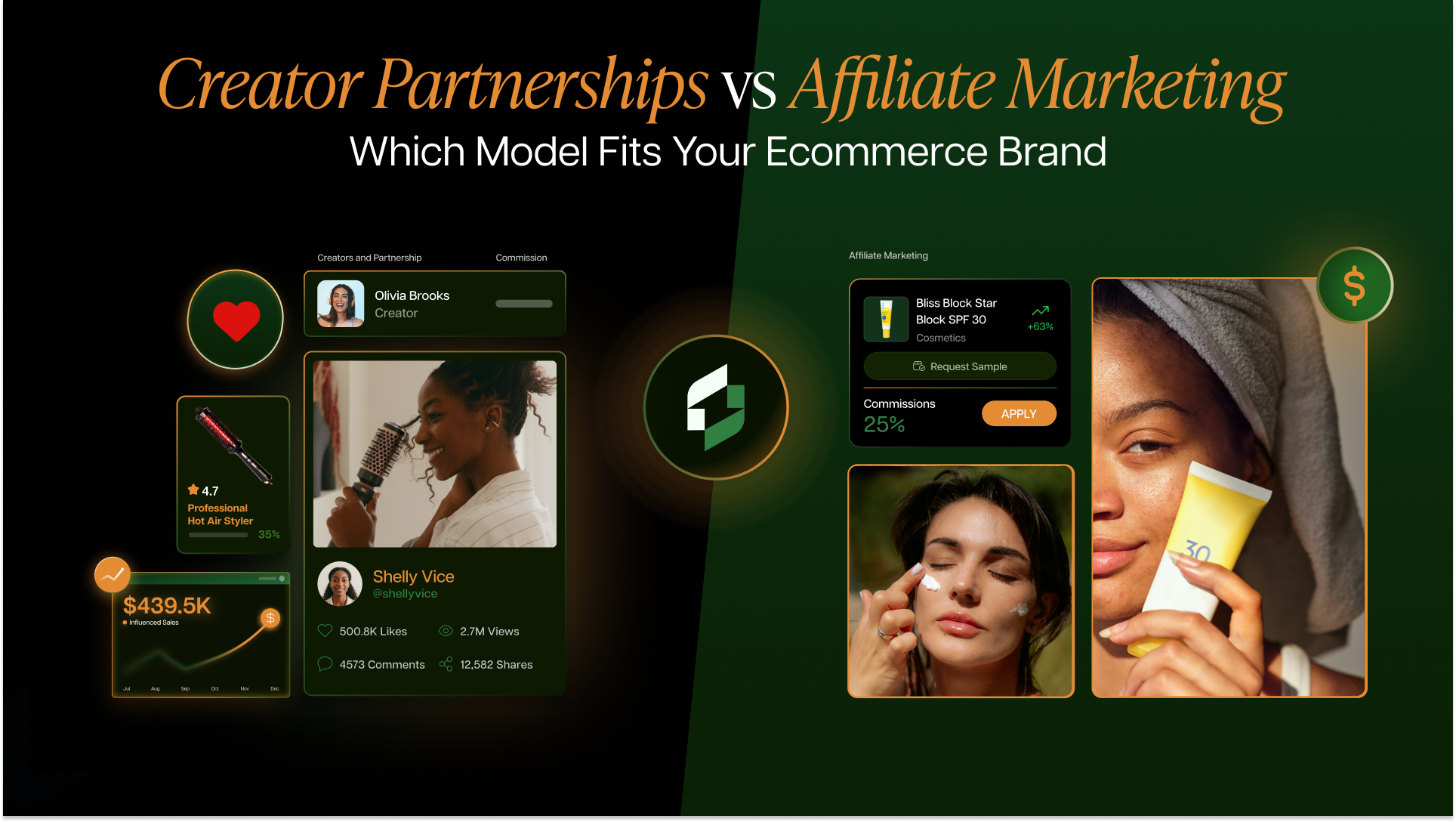
Creator Partnerships vs Affiliate Marketing Comparison
| Comparison Area | Creator Partnerships | Affiliate Marketing | Best Fit Signal |
| Core Purpose | Build trust, awareness, and content demand | Drive measurable revenue | Depends on growth goal |
| Typical payment model | Flat fee, gifting, hybrid, usage rights | Commission, CPA, CPL, CPS, CPC | Depends on cash flow preference |
| Funnel strength | Top and mid funnel | Mid and bottom funnel | Depends on customer journey |
| Asset creation | Strong content and UGC generation | Usually weaker asset creation | Better for content-hungry brands |
| Attribution clarity | Moderate unless tracked well | Usually stronger | Better for performance-first teams |
| Brand control | Higher through briefs and approvals | Lower across many publishers | Better for brand-sensitive categories |
| Scalability | Often slower to scale manually | Often easier to scale through programs | Better for lean teams |
| Trust driver | Creator audience relationship | Offer, incentive, intent, placement | Depends on product and audience |
| Best for | New demand creation | Demand capture and conversion | Depends on maturity |
| Common risk | Paying for content with weak conversion path | Over-indexing on last-click or discount dependency | Needs balance |
How Each Model Works Across the Ecommerce Funnel

Creator Partnerships at the Top and Middle of Funnel
Creator partnerships are particularly effective at the beginning of the customer journey.
Creators introduce products to audiences who may not have been actively searching for them. Through storytelling and demonstration, they build trust and curiosity around the product.
Creator content helps brands:
- Generate awareness
- Educate potential customers
- Build credibility through social proof
- Create reusable marketing assets
Additionally, creator content also has long-term value. A single video review or product tutorial can continue influencing purchase decisions months after it is published.
This is why many brands view creator partnerships as a key driver of creator-led growth.
Affiliate Marketing at the Middle and Bottom of Funnel
Affiliate marketing often shines later in the funnel.
Partners who operate as affiliates typically capture existing purchase intent. A consumer might already be researching the product category and encounter a review, recommendation, or comparison article.
Affiliate programs work well because they align incentives:
- Lower-risk payout model
- Cleaner attribution
- Strong fit for conversion-focused teams
- Scalable economics
- Ability to activate many partner types
The partner promotes the product because they earn commission when it sells. The brand only pays when revenue occurs.
This structure makes affiliate marketing particularly attractive for performance-focused teams.
Where Hybrid Models Come In
Many brands eventually combine creator partnerships and affiliate marketing into a hybrid model.
In this structure, creators produce content while also earning commission from the sales they generate. Payment often follows a hybrid model as well, combining a flat fee for content creation with performance-based commission.
This hybrid approach solves two challenges. First, it gives creators guaranteed compensation for producing content. Second, it allows brands to track the performance of that content through affiliate attribution.
It also enables a more complete partnership strategy. Creators drive awareness and product discovery at the top of the funnel, while affiliate incentives reward the partners who convert that interest into measurable sales.
Over time, the relationship can evolve from a one-off collaboration into an ongoing affiliate partnership.
This is why many brands no longer treat creator and affiliate as separate channels.
”When we looked at our growth strategy, it became clear we didn’t need to choose between creator partnerships and affiliate marketing. Creators helped us build awareness and trust, while affiliate incentives made it easy to measure and scale the partnerships that were actually driving sales. The blended model ended up giving us the best of both.
Joan HigginsAffiliate Marketing Manager
Measurement Context
Another reason affiliate infrastructure has become important is measurement. Modern partnership programs track much more than just direct sales. Brands want visibility into metrics like:
- Impressions
- Conversions
- New-to-brand customers
- Halo effects across marketplaces
For example, 87% of Levanta-driven sales are new-to-brand customers, showing that creator and affiliate partnerships can meaningfully expand a brand’s customer base.
Which Model Fits Different Types of Ecommerce Brands

Choose Creator Partnerships First If Your Brand Needs…
Creator partnerships often make sense as the first investment when a brand needs:
- More awareness
- Stronger social proof
- Product education
- Reusable creative assets
- Demand creation before search intent exists
This is common for newer brands or products that require explanation.
Choose Affiliate Marketing First If Your Brand Needs…
Affiliate marketing is often the stronger first move when a brand prioritizes:
- Measurable revenue contribution
- Low-risk payouts
- Scalable partner recruitment
- Clear attribution
- Conversion-focused growth
Brands with strong existing demand often benefit from launching affiliate programs earlier.
Use Both If Your Brand Needs…
Many mature ecommerce brands eventually run both models together. A hybrid partnership strategy can provide:
- Awareness and discovery
- Conversion capture
- Content creation and revenue generation
- Multiple touchpoints across the customer journey
I am text block. Click edit button to change this text. Lorem ipsum dolor sit amet, consectetur adipiscing elit. Ut elit tellus, luctus nec ullamcorper mattis, pulvinar dapibus leo.
This combination is often where partnerships become a long-term growth engine.
Decision Filters for Founders and Growth Leaders
Product Type
Does the product require explanation or demonstration? Is it story-led, or do things like product reviews influence conversion?
Highly visual or educational products often benefit from creator partnerships.
Margin Structure
Can the brand afford upfront creator payments, or is a commission-only model more sustainable?
Affiliate programs are often easier to launch when budgets are constrained.
Brand Stage
Is this a new or scaling DTC brand? Are they omnichannel or focused on one singular channel?
New brands often start with creator partnerships to generate awareness. Established brands with existing demand may prioritize affiliate programs.
Measurement Maturity
Can the brand track links and code usage or are they relying on last-click logic? Does the brand understand how to measure halo effects?
If your team can track links, codes, and partner attribution, affiliate programs become easier to manage.
Without measurement infrastructure, evaluating performance can be difficult.
Real-World Scenario
A Mid-Market Skincare Brand Deciding Where to Invest
Imagine a premium skincare brand evaluating partnership marketing for the first time.
Brand Situation
The brand has strong product reviews, modest paid advertising efficiency, limited non-branded search demand, and no partnership program yet.
Leadership is debating whether to invest in creators or affiliate partnerships first.
Path 1: Starting with Creator Partnerships
If the brand begins with creator partnerships, it might collaborate with skincare creators who demonstrate the product in tutorials and reviews.
The result is authentic content showcasing the product with stronger social proof and reusable creative assets for paid campaigns.
Demand grows, but attribution may initially be less precise.
Path 2: Starting with Affiliate Marketing
If the brand launches an affiliate program first, publishers and review sites begin recommending the product through tracked links.
The result is clear revenue attribution, measurable performance, and scalable partner recruitment.
However, if brand awareness is still low, results may grow slowly.
Strategic Perspective
The best starting point depends on the brand’s bottleneck.
If demand is weak, creator partnerships can help build awareness.
If demand exists but conversion capture is inefficient, affiliate marketing may deliver faster results.
Desire Stage: Things To Consider Before Investing
Before launching either model, brands should evaluate:
- Margin tolerance
- Average order value
- Repeat purchase behavior
- Content requirements
- Partner management capacity
- Attribution readiness
Partnership programs succeed when both economics and operations support them.
How to Self-Select the Right Model for Your Brand
The Five-Question Framework
- Do we need more discovery or more measurable conversions?
- Can we afford upfront creator payments?
- Does our product require explanation to sell well?
- Do we have the tracking infrastructure to measure partner performance?
- Are we optimizing for short-term revenue or long-term brand growth?
KPIs for Creator Partnerships
- Reach
- Engagement
- Saves
- Branded search growth
- Assisted conversions
- Content reuse value
KPIs for Affiliate Marketing
- Clicks
- Add-to-Carts
- Conversion rate
- Revenue per partner
- Cost per acquisition
- Average order value
- Partner activation rate
Frequently Asked Questions
Are creator partnerships the same as affiliate marketing?
No. Creator partnerships focus on content collaboration, while affiliate marketing rewards partners when measurable actions occur.
Which model is better for a new ecommerce brand?
It depends on the brand’s bottleneck. Brands needing awareness may start with creators, while brands with demand may benefit from affiliate programs.
Is affiliate marketing better for direct sales?
Affiliate programs often perform well for direct sales because payouts are tied to measurable outcomes.
Are creator partnerships only for awareness?
No. Creator partnerships can influence awareness, consideration, and even direct sales.
Can creators also work as affiliates?
Yes. Many creator programs combine content partnerships with affiliate commissions.
How should brands pay creators?
Creator compensation may include flat fees, product gifting, commissions, or hybrid models.
How should brands pay affiliates?
Affiliate partners are typically paid through commissions on sales, clicks, or leads.
How do you measure ROI from creator partnerships?
Metrics include engagement, traffic, assisted conversions, and content performance.
How do you measure ROI from affiliate marketing?
Affiliate ROI is typically measured through clicks, conversion rate, revenue, and cost per acquisition.
Should brands use both models?
Many ecommerce brands eventually combine creator partnerships and affiliate programs for full-funnel coverage.