
TL;DR
The data from our year-over-year analysis of 390 Amazon brands across Prime Day 2024 and Prime Day 2025 makes a clear case for affiliate as the channel to anchor your Prime Day 2026 strategy. Here’s the short version.
- Amazon PPC efficiency is declining. During Prime Day 2025, Sponsored Products spend grew 20% year over year while attributed sales grew only 5%, putting ROAS roughly 12.5% lower than the year prior (Tinuiti).
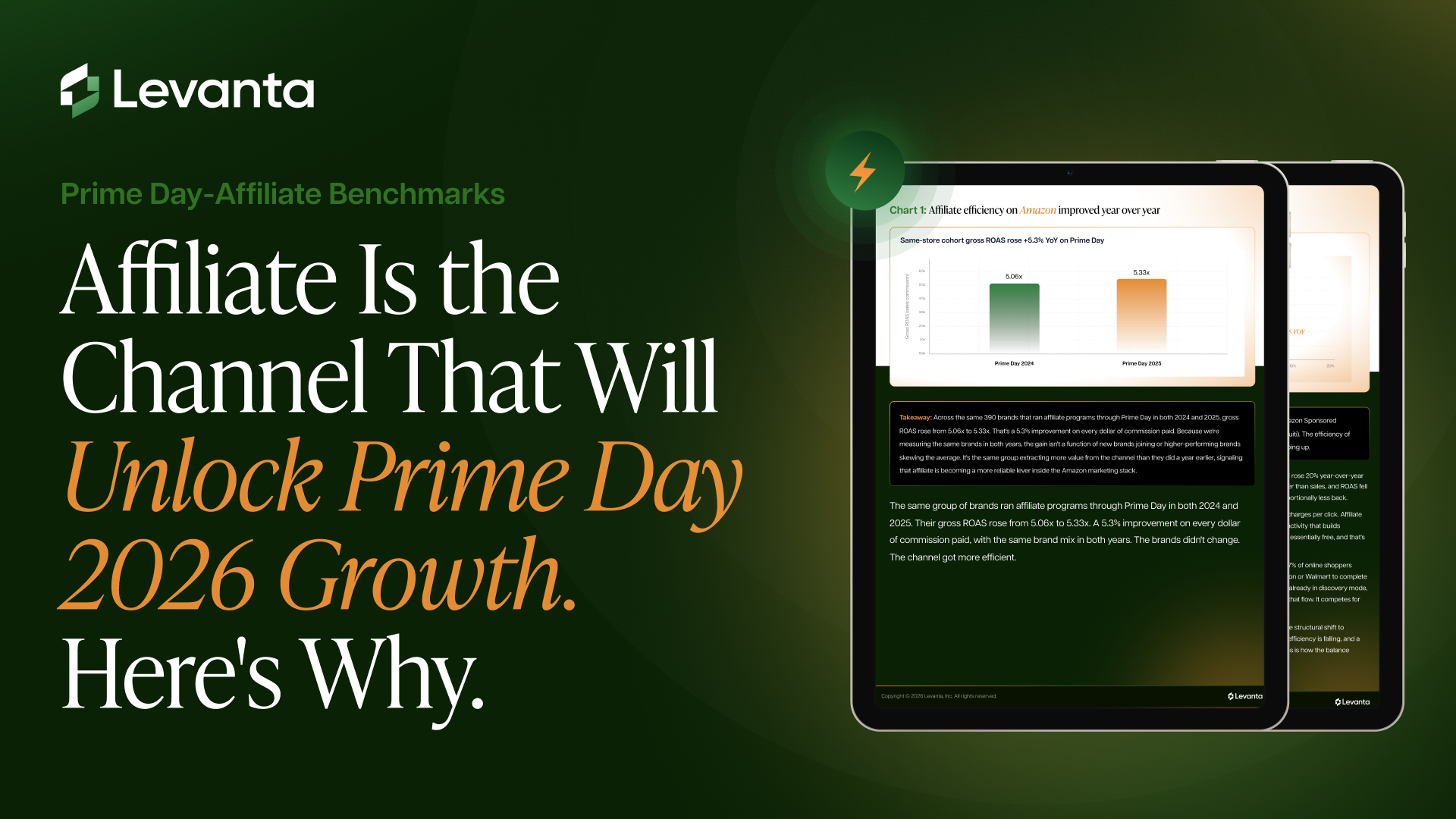
- Affiliate efficiency is rising. The same 390 brands in our cohort saw affiliate ROAS climb 5.3% year over year, even as PPC moved in the opposite direction.
- Prime Day is no longer a four-day spike. It’s a multi-week activation window. Cohort sales held above baseline for the full eight weeks before Prime Day 2025 and stayed 57% above baseline the week after the event ended.
- The brands winning at affiliate aren’t optimizing tactics. They’re pricing commissions against lifetime value, building creator portfolios that cover the full buying journey, and activating across the lead-in, event, and halo windows.
- The full data and framework live in the report. [Download it here.]
I run marketing at Levanta, which means I don’t run Prime Day campaigns. The brands on our platform do. What I get is the view from behind those programs. We just published a year-over-year analysis of 390 Amazon brands that ran affiliate through both Prime Day 2024 and Prime Day 2025, and the patterns in that data made a sharper case for affiliate as a Prime Day channel than I expected going in.
I want to walk through the case the same way I walked through it internally, because the conclusion only makes sense if you see how the pieces connect. If you’re planning Prime Day 2026 right now, this is the angle worth thinking about.
The Amazon PPC math has shifted, and it’s getting harder to ignore
For most Amazon sellers, PPC is still the largest line item in the marketing budget. That made sense for a long time. PPC moves volume, the attribution is clean, and the dashboard tells you exactly what you got for your spend.
The problem is that what you’re getting for your spend has been declining. According to Tinuiti’s Prime Day 2025 analysis, Sponsored Products spend grew 20% year over year while attributed sales grew only 5%. When you do the math on that, ROAS came out roughly 12.5% lower than the year before. Brands paid significantly more in 2025 and got proportionally less back.
That’s not a tactical execution problem. It’s structural. PPC charges per click, which means every brand running it dials spend up at the same time during peak windows. When everyone bids harder, CPCs rise, ROAS compresses, and the channel becomes less efficient at exactly the moment brands need it to perform. Prime Day is the most concentrated version of that dynamic.
If you’ve been feeling like your PPC numbers don’t go as far as they used to, the data backs up what you’re seeing.
Affiliate is moving in the other direction
This is where the comparison gets interesting. The 390 brands in our cohort that ran affiliate programs through Prime Day in both 2024 and 2025 saw affiliate ROAS climb 5.3% year over year. Same brands, same channel, more efficiency.

Two channels, measured in the same Prime Day window, moving in opposite directions. That’s the pattern worth paying attention to.
The reason isn’t that affiliate marketers are better tacticians than PPC marketers. The reason is the cost structure. Affiliate charges per sale, not per click. Brands don’t have to dial creator activity up or down based on willingness to pay during a peak window, because there’s no per-impression cost to keeping the channel running. The economics let it operate continuously, which means it’s still earning sales in the windows where PPC has been pulled back.
Prime Day has become a multi-week activation window
If you’re still planning Prime Day around the four event days, you’re working from outdated assumptions. Two findings from our data make that clear, and I want to be careful about how I present them because they measure different things.
The first finding is total event volume. Across the cohort, per-brand event sales grew 16.9% from 2024 to 2025. The event itself doubled in length from two days to four, so some of that growth comes from having twice as many days to sell. The takeaway is that the longer event format is producing more total volume per brand, not that the per-day intensity got higher.
The second finding is what happened around the event, which is measured differently. We indexed weekly cohort sales to each year’s W1 baseline so we could compare the shape of each lead-in. In 2024, sales dipped during the eight weeks before Prime Day, consistent with shoppers holding spend in anticipation of deals. In 2025, that dip didn’t happen. Cohort sales held above baseline across the entire eight-week lead-in.
The post-event window also became active. Cohort sales the week after Prime Day 2025 sat 57% above the pre-event baseline before reverting in the second week. That’s the post-event halo, and it represents real volume most brands aren’t activating against.
Two different measurements, one consistent picture. The total event window is bigger and the periods around the event are no longer dormant. Prime Day is now a multi-week activation, which is exactly the kind of window affiliate is structurally built to operate inside.
What the brands extracting the most value from affiliate are doing differently
I’ll be transparent that the rest of this section is where we get into the strategic depth, and I’m going to tease three things rather than giving the full framework away. The framework lives in the report.
Brands at the top of every category’s commission range are pricing the channel against lifetime value, not single-order margin. Most Amazon sellers were trained to think about commissions through unit economics, where margin minus commission has to equal profit on the transaction. That framework caps commissions at single-digit percentages for most categories. The brands paying meaningfully higher rates are running a different calculation, one that accounts for repeat purchases and the long-term value of an acquired customer. The math gets you to a very different ceiling.
This is also why commission rates within the same category vary by 10 percentage points or more, even between brands selling to the same customers. The gap is a strategy gap, not a market gap.

The same brands are also building creator portfolios that cover the full buying journey rather than concentrating spend in the highest-efficiency creator type. Every creator type the cohort worked with generated positive incremental returns as the channel scaled in 2025. The narrow spread between the top and bottom performer is the more important insight, because it suggests diversification doesn’t dilute performance the way you might expect.
And they’re activating across the full Prime Day window, not just the event days. Lead-in active, event days active, post-event halo active. Three windows, one continuous strategy.
What this means for your Prime Day 2026 plan
I’m not going to pretend I’m the one running these programs. But I am the one looking at the aggregate behavior, and the data points to a few things worth thinking about as you plan.
Start with an honest audit of your channel mix. If your Amazon marketing budget is still weighted heavily toward PPC and you’re feeling the efficiency squeeze, the data suggests rebalancing toward affiliate is going to outperform pushing harder on PPC.
Plan affiliate activation for the full Prime Day window, not just the event days. The lead-in is active, the post-event week is active, and your strategy should be too. The brands earning the most across our cohort showed up in all three.
Pressure-test your commission strategy against your actual LTV math. If you’re pricing commissions based on single-order margin, you’re probably leaving the channel underfunded. Run the numbers on what a customer is worth over their full relationship with your brand and let that ceiling guide your decisions.
Look at your creator portfolio honestly. If you’re working with one or two creator types, expanding to cover more of the buying journey is likely to add efficiency rather than dilute it.
And set up measurement that matches the multi-week reality of the event. Single-day or single-week dashboards miss the lead-in and the halo. The brands operating with full visibility are going to make better calls than the brands optimizing to a four-day spike.
The full data and framework live in the report
Everything I’ve referenced here comes from our Prime Day Affiliate Benchmark Report, a year-over-year analysis of 390 Amazon brands that ran affiliate programs through Levanta during both Prime Day 2024 and Prime Day 2025. The report breaks down the methodology, the category-level commission ranges, the five creator type efficiency rankings, and the framework the top brands are using to price the channel correctly.
If you want the full picture, you can [download the report here]. It’s free, no strings, and Prime Day 2026 is the right window to plan against.
The math is clear. The channel is ready. The brands that recalibrate now are the ones that win.
— Richie
Frequently Asked Questions
When is Amazon Prime Day 2026?
Amazon hasn’t officially confirmed Prime Day 2026 dates as of this writing. Industry reporting suggests the event may move to late June 2026, breaking from its traditional July window, with a four-day format consistent with Prime Day 2025. Sellers should plan for a tighter pre-event timeline than in past years and watch for Amazon’s official announcement, which historically comes three to four weeks before the event.
Why is Amazon PPC efficiency declining?
Amazon PPC efficiency has been declining because the channel is structurally built for peak windows. PPC charges per click, which means brands compete most aggressively during high-traffic events like Prime Day. When everyone bids harder at once, CPCs rise and ROAS compresses. According to Tinuiti’s Prime Day 2025 analysis, Sponsored Products spend grew 20% year over year while attributed sales grew only 5%, putting ROAS roughly 12.5% lower than the year before.
Is affiliate marketing better than PPC for Amazon sellers?
The two channels serve different functions, but the efficiency math is moving in opposite directions on Amazon. Across the same 390 brands measured in both Prime Day 2024 and Prime Day 2025, affiliate ROAS climbed 5.3% year over year while Amazon PPC ROAS declined roughly 12.5%. The structural reason is cost mechanics. Affiliate charges per sale rather than per click, which lets the channel run continuously without efficiency penalties during peak windows.
Has Prime Day really become a multi-week activation window?
Yes, based on the cohort data. In 2024, sales dipped during the eight weeks leading into Prime Day as shoppers held spend in anticipation of deals. In 2025, that dip disappeared. Cohort sales held above baseline across the entire eight-week lead-in and stayed 57% above baseline the week after the event before reverting. The combination of an active lead-in, a longer four-day event, and a measurable post-event halo means Prime Day 2026 is best treated as a multi-week activation rather than a single-day spike.
How should I plan affiliate marketing for Prime Day 2026?
Plan for the full multi-week window, not just the event days. The data from Prime Day 2025 shows three active sales periods: the eight-week lead-in, the four-day event, and the post-event halo week. Brands earning the most across the cohort activated across all three. Practical actions include auditing your current channel mix, pressure-testing your commission strategy against lifetime value math, and expanding your creator portfolio to cover more of the buying journey.
What commission rate should I pay creators for Prime Day 2026?
Commission rate decisions should be driven by your customer lifetime value, not single-order margin. Across the cohort, commission rates within the same category vary by 10 percentage points or more, which suggests the brands at the high end of each range are using a different framework than the brands at the low end. The brands paying higher commissions are pricing the channel against the full revenue a customer generates over their relationship with the brand, which produces a meaningfully higher ceiling than single-transaction margin math allows.
Where can I find the full Prime Day 2026 affiliate marketing data?
The full data set and analytical framework live in Levanta’s Prime Day Affiliate Benchmark Report, a year-over-year analysis of 390 Amazon brands that ran affiliate programs through Levanta during both Prime Day 2024 and Prime Day 2025. The report breaks down methodology, category-level commission ranges, the five creator type efficiency rankings, and the strategic framework brands are using to price the channel correctly. [Download the report here.]