
TLDR
Levanta’s Paid Placements for creators enables a structured way to set rates, negotiate brand deals, get paid reliably, and track the actual sales impact of their sponsored content. Whether you are an influencer, publisher, newsletter operator, or UGC creator, Paid Placements replaces the scattered workflow of emails, DMs, spreadsheets, and invoicing with a single system that handles everything from proposal to payout.
What Are Paid Placements and How Do They Work for Creators?
Paid Placements is a system inside Levanta that lets creators manage flat-fee, guaranteed content partnerships with brands in one place.
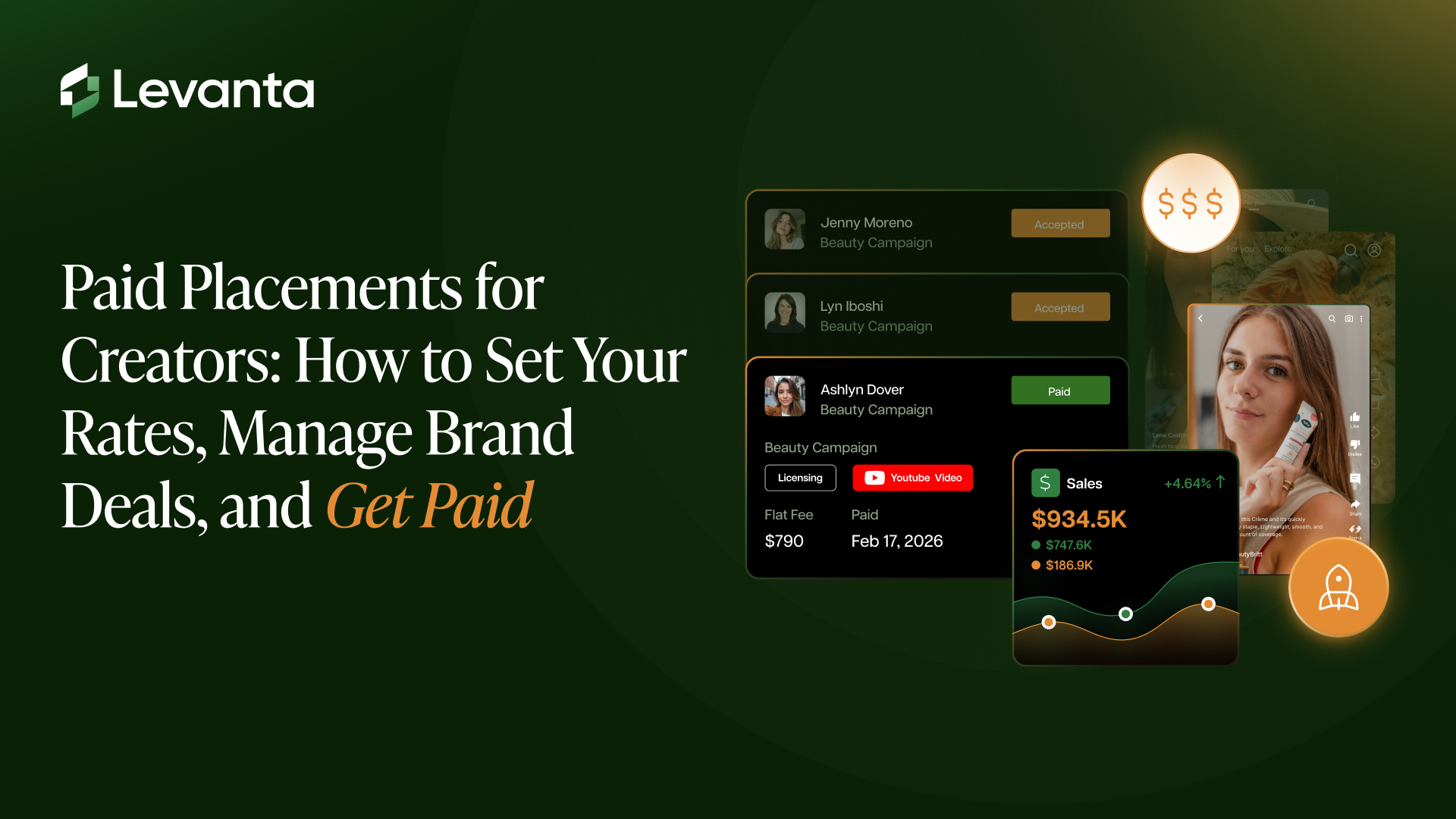
Here is how it works: you set up a rate card that shows brands what you charge and what types of content you offer. Brands browse your rates and submit proposals directly through the platform. You review each proposal, negotiate terms if needed, and accept the deals that make sense for you. Once you agree on deliverables and timelines, Levanta generates a contract automatically. You create the content, submit it for review, publish it, and get paid once the content is verified as live.
The key difference from standard affiliate programs is that you are getting paid a flat fee for guaranteed content, rather than earning commissions based on sales. But Paid Placements also connects to Levanta’s affiliate tracking, which means you can see exactly how your sponsored content performs in terms of actual clicks, conversions, and purchases. That performance data helps you prove your value, price future deals more confidently, and identify which brand partnerships are worth repeating.
Paid Placements is designed to sit alongside affiliate marketing. You can keep earning commissions on your existing affiliate content while using Paid Placements to take on structured, flat-fee brand deals that provide predictable, upfront income.
Which Creators Should Use Paid Placements?
Paid Placements is built for any creator who takes on paid or sponsored brand partnerships and wants a better system for managing those deals.
That includes:
- Influencers with established audiences who regularly accept sponsored content across social platforms like Instagram, TikTok, YouTube, or Facebook.
- Publishers and editorial outlets that offer guaranteed placements such as product reviews, roundup articles, or featured coverage.
- Newsletter operators and media creators who sell sponsorship slots to brands.
- UGC creators producing content that brands license and repurpose across their own channels.
- Marketplace-focused creators who work specifically with Amazon and Walmart brands and want to drive external traffic to product listings.
Paid Placements is especially useful if you already drive results through affiliate marketing and want to turn that proven track record into more predictable, upfront revenue. According to Influencer Marketing Hub, creators with published rate cards close 2.4x more deals annually compared to creators who negotiate pricing from scratch on every project.
If you rely exclusively on organic affiliate links and do not take on any paid sponsorships, Paid Placements may not be relevant to your current workflow. But for creators who do accept sponsored deals, or who want to start, this is the system that makes it manageable.
4 Problems Paid Placements Solve for Creators
Creators who manage sponsored content partnerships typically run into four recurring problems. These apply whether you are an influencer posting on social media, a publisher running editorial content, or a newsletter operator selling sponsorship slots.
1. Pricing Is Unclear at the Start of Brand Conversations
Without a published rate card, every new brand conversation starts with the same back-and-forth: What do you charge? What formats do you offer? What is included? This slows things down and puts you in a reactive position before any real discussion about the partnership can happen.
With Paid Placements, you set clear pricing and available placement types upfront inside your Levanta dashboard. Brands can see what you charge and what you offer before they reach out. This means conversations start from a position of clarity and control, and you spend less time explaining your rates and more time evaluating whether the partnership is actually a good fit.
2. Negotiation and Execution Are Fragmented Across Tools
In a typical sponsored content workflow, pricing discussions happen over email, contracts get handled in a separate tool, content drafts get shared through file storage or messaging apps, and performance tracking lives in yet another platform. Every step is disconnected, which increases the chance of miscommunication and makes it harder to stay organized as you take on more deals.
Paid Placements brings all of those steps into one system. You review proposals, negotiate terms, define deliverables, submit content, and track performance in the same place. Fewer moving parts means fewer misunderstandings and less time spent on operational overhead.
3. Payments Are Unreliable and Require Follow-Up
Getting paid on time is one of the most common frustrations for creators who do sponsored work. Even when terms are clearly agreed to, many creators still end up sending manual invoices, chasing follow-ups, and wondering whether payment will actually come through. According to industry surveys, inconsistent payment timelines are one of the top reasons creators hesitate to take on new brand deals.
Paid Placements solves this with a built-in escrow system. Brands fund the collaboration upfront before you start creating content. That payment is held securely by Levanta until your content is verified as live and matches the agreed terms. Once those conditions are met, the payout is released automatically. No invoicing, no follow-ups, no uncertainty.
4. Creators Have No Visibility into the Sales Impact of Their Content
Most sponsored content performance is measured by impressions, likes, comments, and maybe click-through rates. That tells you how many people saw the content, but it does not tell you whether it actually drove purchases. Without that deeper visibility, it is difficult to prove your real value to brands, negotiate higher rates for future deals, or decide which partnerships are worth repeating.
Paid Placements will track every piece of content from the first impression through to the final sale. You can see how many people clicked through from your content to the brand’s Amazon or Walmart listing and how many of those clicks turned into purchases. According to Levanta platform data, 87% of sales generated through the platform are from new-to-brand customers, which means your content is reaching people who were not already shopping for that product.
That kind of data changes the conversation with brands. Instead of showing engagement screenshots, you can show actual revenue impact. And that performance history helps you command better rates over time.
How Paid Placements Work Inside Levanta
How to Set Up Your Rate Card
You start by creating a rate card in your Levanta dashboard. Your rate card defines pricing for the content formats and platforms you work with, such as Instagram Reels, TikTok videos, YouTube integrations, blog posts, newsletter placements, or any custom format you offer.
Rate cards give brands immediate visibility into what you charge, what types of placements are available, and whether you support affiliate links or commissions alongside the flat fee. This removes guesswork for brands and speeds up the entire outreach process.
You can update your rate card anytime as your audience grows, your engagement rates change, or your pricing evolves.
How to Review and Negotiate Brand Proposals
When a brand is interested in working with you, they submit a paid placement proposal based on your rate card. The proposal includes the content type, pricing, timeline, and any specific guidelines or usage rights.
You can accept the proposal as-is, counter on price or terms, or decline it entirely. All negotiation happens directly in the platform. There are built-in response deadlines to keep conversations moving and prevent deals from stalling out.
This replaces the typical back-and-forth over email and DMs with a structured workflow that keeps everything documented in one place.
How Deliverables, Timelines, and Contracts Work
Once you and the brand agree on terms, the next step is defining the specifics: what content you will create, when it needs to be posted, how many revisions are included, and what usage rights the brand receives.
Levanta generates the contract automatically after terms are finalized. This means you do not need to draft your own agreements or use separate contract tools. The scope, deliverables, and payment terms are all documented before you start working, which protects both you and the brand.
How to Submit Content and Get Verified
After you create the content, you submit it for review inside Levanta. The brand reviews your work, provides feedback, and can request revisions within the agreed timeframe.
Once the content is approved, you publish it and submit proof of posting. For evergreen content, this is typically a live link. For time-limited formats like Instagram Stories, a screenshot works as verification.
How You Get Paid
This is the part that matters most to creators, and it is where Paid Placements is fundamentally different from the way most sponsored content deals work today.
Brands fund the paid placement upfront before you start creating content. Levanta holds that payment securely throughout the process. Once your content is verified as live and meets the agreed terms, the payout is released to you automatically.
You do not need to send invoices. You do not need to follow up. You do not need to worry about whether payment will come through. The money is already committed before you begin, and it is released as soon as the terms are met.
How Paid Placements Compare to Other Creator Workflows
Paid Placements vs. Managing Deals Yourself
Without a centralized system, managing sponsored content means juggling email threads, DM conversations, separate contract tools, content storage platforms, invoicing software, and affiliate dashboards. Every deal lives across multiple tools, which makes it harder to stay organized as your workload grows.
Paid Placements consolidates all of these steps into one workflow. Negotiation, contracts, content review, verification, payment, and performance tracking happen in a single place. This saves you time and reduces the risk of details falling through the cracks.
Paid Placements vs. Building Your Own Systems
Many creators build their own spreadsheets, templates, and tracking systems to manage sponsored content. These workarounds can work when you are handling a few deals at a time, but they become increasingly difficult to maintain as your business scales. They also make it harder to bring on help or transition deals smoothly.
Paid Placements replaces those ad-hoc systems with a standardized, repeatable process that scales with your business.
Paid Placements vs. Affiliate-Only Income
Affiliate programs are a reliable way to earn ongoing commissions from your content. Brands pay you a percentage of each sale your content drives, which means your earnings scale with your performance. And as Levanta’s Affiliate After AI report shows, affiliate content also supports top-of-funnel brand discovery, making it a versatile income channel.
The challenge is that affiliate income alone can be unpredictable. Your earnings depend on factors like conversion rates, product pricing, and seasonal demand. And some brands, particularly newer ones, may not offer commission rates that feel worth the effort of creating dedicated content.
Paid Placements gives you a guaranteed flat fee for specific content. You know exactly what you will earn before you start working. When paired with affiliate tracking, you can also see how that content performs over time, which helps you decide which brand relationships to invest in long-term.
The strongest approach for most creators is to use both: Paid Placements for structured campaigns where you want upfront compensation, and affiliate links for ongoing recommendations where you earn performance-based income over time.
When Should Creators Use Paid Placements, and When Should They Not?
Paid Placements is a good fit when:
- A brand wants guaranteed content published on a specific timeline.
- You want upfront compensation for your work before you start creating.
- The deal requires defined deliverables, revision windows, or content usage rights.
- You want to track how your content actually performs in terms of real sales, not just engagement metrics.
- You are working with Amazon or Walmart brands and want to connect your content to measurable purchase data.
Affiliate-only models may work better when:
- Your content is purely organic and not tied to a specific brand deal.
- You prefer performance-based monetization where your earnings scale with sales.
- No guaranteed placement or specific posting timeline is required.
The ideal setup for most creators is a combination of both.
Use Paid Placements for structured brand campaigns that provide predictable income. Use affiliate links for ongoing product recommendations that continue to earn commissions over time. Together, this hybrid approach gives you both reliable revenue and long-term earning potential from the same brand partnerships.
Key Takeaways
- Paid Placements gives creators a structured system to set rates, manage brand deals, and get paid reliably for sponsored content.
- Your rate card is visible to brands upfront, which speeds up outreach and helps you start conversations from a position of control.
- Negotiation, contracts, content review, payment, and performance tracking all happen in one platform.
- Brands fund placements upfront, and payment is released automatically once your content is verified as live. No invoicing, no chasing follow-ups.
- Full-funnel tracking shows you how your content performs from the first impression through to the final sale, giving you real data to negotiate better rates and choose the right partnerships.
- Paid Placements works best as a complement to affiliate marketing, combining upfront flat-fee income with ongoing performance-based commissions.
Get Started with Paid Placements on Levanta
If you are already a creator on Levanta, Paid Placements is available now inside your dashboard.
If you are not yet using Levanta, get started to see how Paid Placements lets creators set rates, manage brand deals, get paid reliably, and track the real sales impact of their sponsored content.
Frequently Asked Questions About Paid Placements for Creators
What is Paid Placements?
Paid Placements is a feature inside Levanta that lets creators manage flat-fee, guaranteed content partnerships with brands. You set your rates, review proposals, negotiate terms, submit content, and get paid once the content goes live. Everything happens in one platform.
How is Paid Placements different from regular affiliate marketing?
With affiliate marketing, you earn commissions when someone clicks your link and makes a purchase. Your earnings depend on conversion rates and sales volume. With Paid Placements, you earn a guaranteed flat fee for producing and publishing specific content. You can use both at the same time. Many creators layer affiliate links into their paid placement content to earn upfront compensation plus ongoing commissions.
What types of creators can use Paid Placements?
Paid Placements supports a wide range of creator business models. This includes social media influencers, YouTube creators, publishers and editorial sites, newsletter operators, UGC creators, loyalty platforms, and media outlets. If you produce content for brands and want a structured way to manage those deals, Paid Placements is designed for you.
How do I set my rates?
You create a rate card in your Levanta dashboard. Your rate card lists pricing for the content formats you offer, such as social posts, videos, blog articles, newsletter mentions, or custom formats. Brands see your rate card before reaching out, so they already know your pricing when they submit a proposal.
How does payment work?
Brands fund the placement upfront before you start creating content. Levanta holds the payment securely until your content is verified as live and matches the agreed terms. Once those conditions are met, payout is released to you automatically. You never need to send an invoice or chase follow-ups.
Can I track how my sponsored content performs?
Yes. Paid Placements connects to Levanta’s affiliate tracking infrastructure, which means you can see how your content performs from the initial view through to the final purchase on Amazon or Walmart. You get visibility into clicks, conversions, and sales, not just impressions and engagement. This data helps you prove your value to brands and negotiate better rates on future deals.
Do I have to stop doing affiliate marketing to use Paid Placements?
No. Paid Placements is designed to complement affiliate marketing. You can continue earning commissions through your affiliate content while using Paid Placements for structured, flat-fee brand deals. Many creators find that the combination of upfront flat-fee income and ongoing affiliate commissions is the most effective monetization strategy.
Which brands use Paid Placements on Levanta?
Levanta works primarily with ecommerce brands selling on Amazon and Walmart. These are brands looking to drive external traffic to their product listings through creator and editorial content. If you create content related to products sold on those marketplaces, Paid Placements connects you directly with brands that have budget for guaranteed creator partnerships.